
CSIR NET June 2016 Q30: General Earth Science
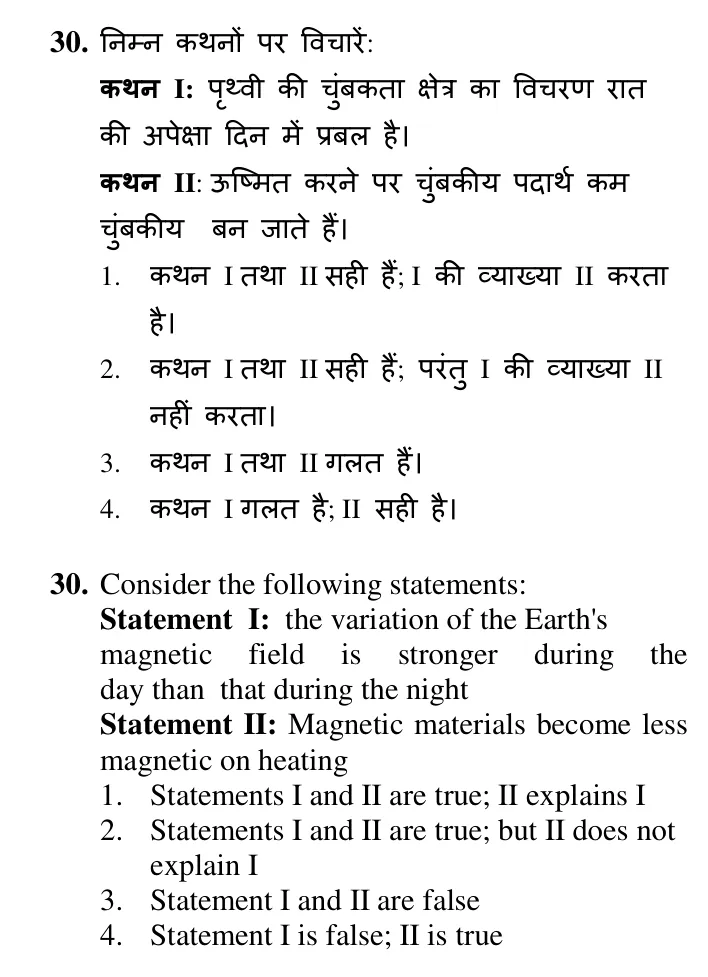
Assertion-reason type statements should be evaluated independently for truth, and then separately for whether one logically explains the other. The diurnal (daily) variation of Earth's magnetic field is driven by solar-heating-induced ionospheric current systems, which is a distinct physical mechanism from the thermal demagnetization (Curie point) behaviour of magnetic minerals.
Statement I is true: the diurnal variation of Earth's magnetic field is indeed stronger during the day than at night. This is because solar (UV/X-ray) radiation ionizes the upper atmosphere more strongly during daylight hours, driving stronger ionospheric electric currents (the Sq current system), which in turn produce larger magnetic field variations at the surface.
Statement II is also true: magnetic materials do become less magnetic when heated, because thermal energy progressively disrupts the alignment of magnetic domains, and above the Curie temperature they lose ferromagnetism almost entirely.
However, Statement II does not explain Statement I. The day-night difference in geomagnetic field variation is caused by changes in ionospheric electric currents due to solar radiation, not by any heating-related change in the magnetic properties of Earth's internal or crustal rocks. These are two unrelated physical phenomena.
Option 1 says II explains I — incorrect, because the mechanisms are unrelated (ionospheric currents vs. thermal demagnetization).
Option 2 is correct: both statements are true, but II does not explain I.
Option 3 says both are false — incorrect, since both statements are independently true and well-established.
Option 4 says I is false — incorrect, since the diurnal variation being stronger during the day is a well-documented geomagnetic phenomenon.