
CSIR NET June 2016 Q31: Petrology & Mineralogy
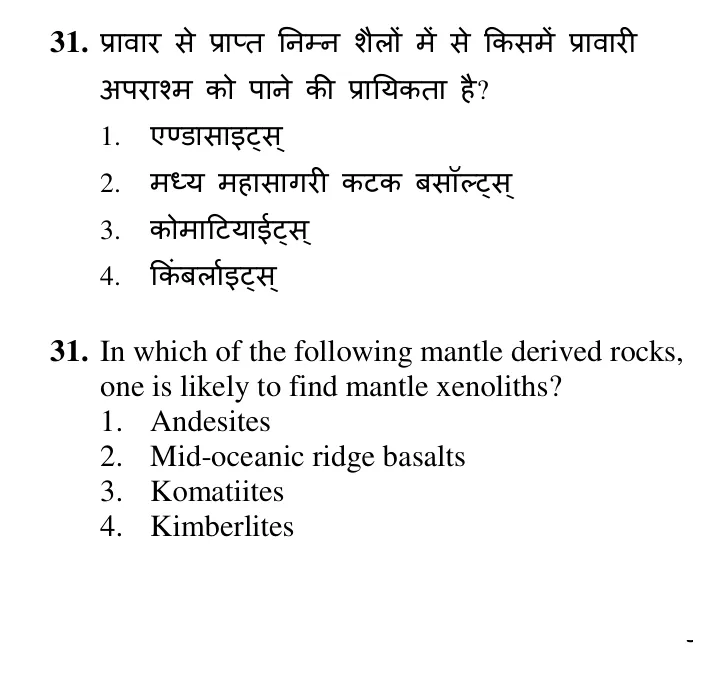
Mantle xenoliths (fragments of mantle rock carried up intact within a host magma) are best preserved in magmas that ascend extremely rapidly from great depth, minimizing the time available for the xenoliths to react with, dissolve into, or thermally equilibrate with the surrounding melt.
Kimberlites are famous for their extremely rapid, deep-sourced ascent (originating in the mantle, sometimes below 150 km depth, and reaching the surface in a matter of hours via narrow, violently erupting diatreme pipes). This unusually fast transport means there is little time for xenoliths of mantle peridotite (and even diamonds) entrained in the magma to be destroyed or altered, so they are commonly preserved intact in kimberlite pipes.
Andesites, mid-oceanic ridge basalts, and komatiites, by contrast, either originate from shallower mantle melting, undergo more prolonged ascent and crystallization, or involve processes (like extensive fractional crystallization or crustal contamination) that are far less favorable for preserving intact mantle xenoliths.
Andesites, mid-oceanic ridge basalts, and komatiites, by contrast, either originate from shallower mantle melting, undergo more prolonged ascent and crystallization, or involve processes (like extensive fractional crystallization or crustal contamination) that are far less favorable for preserving intact mantle xenoliths.
Option 1 (Andesites) is incorrect; andesites form mainly at subduction zones from more evolved, crustally-contaminated magmas, not conditions favorable for xenolith preservation.
Option 2 (Mid-oceanic ridge basalts) is incorrect; MORB forms via relatively slow decompression melting near the surface at ridges, without deep, rapid transport of xenoliths.
Option 3 (Komatiites), while also mantle-derived and hot, are ancient, mostly Archean lavas whose eruption style does not typically preserve xenoliths as reliably as kimberlites.
Option 4 (Kimberlites) is correct, as explained above — their rapid, deep ascent is the classic mechanism for delivering intact mantle xenoliths (and diamonds) to the surface.