
CSIR NET June 2016 Q71: Igneous Petrology
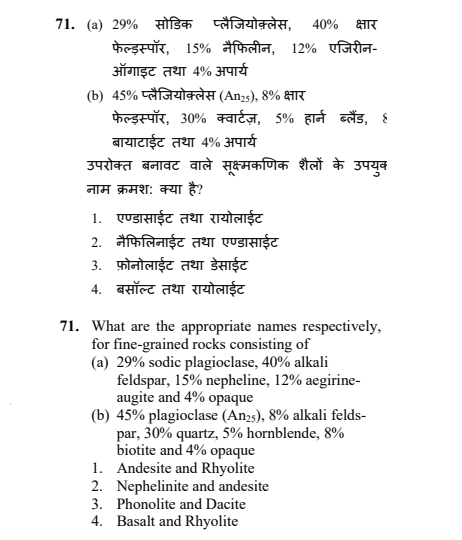
Igneous rocks are classified by modal mineralogy on the QAPF diagram (Quartz – Alkali feldspar – Plagioclase – Feldspathoid). Quartz and a feldspathoid (nepheline, leucite, etc.) never occur together in the same rock — one branch of the diagram is silica-oversaturated (quartz-bearing: granite→rhyolite, diorite→andesite/dacite, gabbro→basalt), the other is silica-undersaturated (feldspathoid-bearing: foid syenite→phonolite, foid gabbro→tephrite/basanite).
Rock (a): 15% nepheline (a feldspathoid) present, alkali feldspar (40%) exceeds plagioclase (29%) → feldspathoid-bearing branch, alkali-feldspar-dominant field → fine-grained equivalent is Phonolite. Rock (b): 30% quartz, plagioclase (An25, 45%) exceeds alkali feldspar (8%), with hornblende + biotite → quartz-bearing branch, plagioclase-dominant, high-quartz field → fine-grained equivalent is Dacite. Answer: (3) Phonolite and Dacite
1. Andesite + Rhyolite — wrong. Andesite is a silica-saturated calc-alkaline rock with no feldspathoid; rock (a)'s 15% nepheline rules it out entirely. Rhyolite needs far more combined quartz + alkali feldspar than rock (b) shows. 2. Nephelinite + Andesite — wrong. Nephelinite requires nepheline to dominate with feldspar minor/absent; rock (a) is 69% combined feldspar, too feldspar-rich to be nephelinite. 3. Phonolite + Dacite — correct. 4. Basalt + Rhyolite — wrong. Basalt is plagioclase-dominant with no significant alkali feldspar or nepheline; rhyolite again needs higher quartz/alkali-feldspar content than rock (b).