
CSIR NET June 2016 Q29: Geophysics
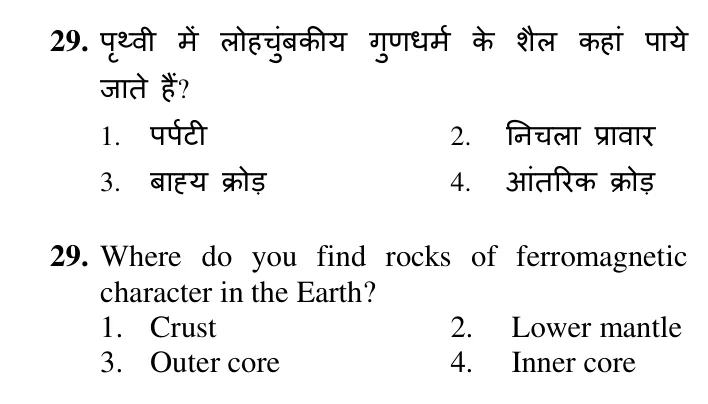
Ferromagnetism in minerals (e.g. magnetite) only persists below a critical temperature called the Curie point (~580°C for magnetite). Above this temperature, thermal agitation destroys the ordered magnetic domains, and the material becomes only weakly (paramagnetic) magnetic.
Earth's internal temperature rises steadily with depth, and this geothermal gradient means that below a certain depth in the crust (and definitely by the upper mantle), rock temperatures exceed the Curie point of common magnetic minerals like magnetite. Once past the Curie point, rocks lose their ferromagnetic character.
Because temperatures in the crust are generally below the Curie point (except locally, e.g. near very deep crustal roots or magmatic zones), it is only crustal rocks that can retain strong ferromagnetic properties. The mantle and core are far too hot for ferromagnetism to persist (even though the core is iron-rich, it is far above the Curie point and behaves differently, contributing to the geomagnetic field through fluid dynamo action rather than as a simple ferromagnet).
Because temperatures in the crust are generally below the Curie point (except locally, e.g. near very deep crustal roots or magmatic zones), it is only crustal rocks that can retain strong ferromagnetic properties. The mantle and core are far too hot for ferromagnetism to persist (even though the core is iron-rich, it is far above the Curie point and behaves differently, contributing to the geomagnetic field through fluid dynamo action rather than as a simple ferromagnet).
Option 1 (Crust) is correct — the crust is the only zone consistently cool enough (below the Curie point) for rocks to retain ferromagnetic behaviour.
Option 2 (Lower mantle) is incorrect; temperatures there vastly exceed the Curie point of common magnetic minerals.
Option 3 (Outer core) is incorrect; despite being iron-rich and liquid, it is far too hot for simple ferromagnetism (its magnetic field arises via dynamo action, not static ferromagnetism).
Option 4 (Inner core), though solid and iron-rich, is at extremely high temperature, well above any mineral's Curie point, so it is not ferromagnetic in the conventional sense either.