
CSIR NET June 2016 Q86: Physical Oceanography
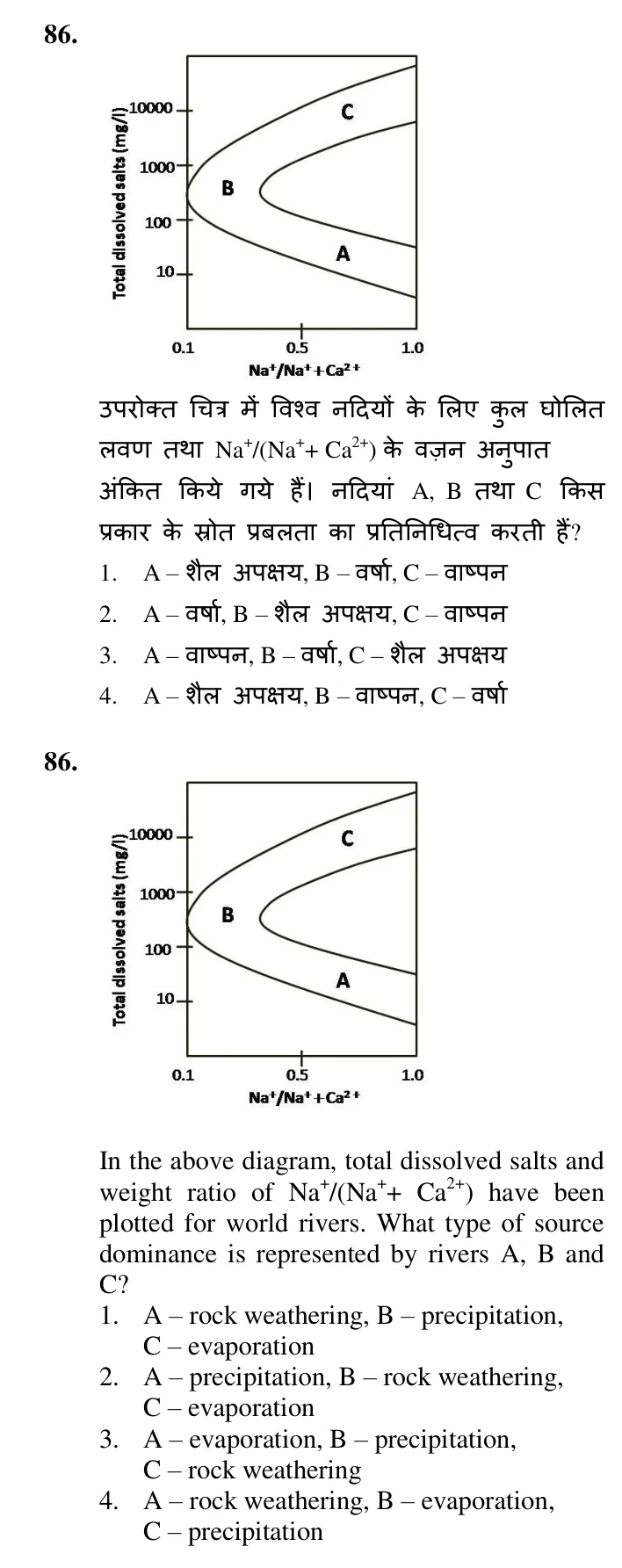
The Gibbs diagram (boomerang plot) of total dissolved salts (TDS) versus Na+/(Na+ + Ca2+) weight ratio for world surface waters distinguishes three end-member controls on water chemistry: precipitation dominance, rock (weathering) dominance, and evaporation-crystallization dominance.
In the classic Gibbs plot, the lower-right limb (low TDS, high Na+/(Na++Ca2+) ratio, since rainwater carries proportionally more cyclic marine Na+ salts despite low total solute load) represents precipitation dominance (A). The central, low-ratio, low-to-moderate TDS limb represents rock weathering dominance (B), where Ca2+ from silicate/carbonate weathering lowers the Na ratio. The upper-right limb (high TDS, high Na ratio due to concentration by evaporation and preferential precipitation of Ca-carbonate) represents evaporation-crystallization dominance (C). Option 2 is correct.
1) Incorrect — swaps evaporation and precipitation source roles for A/C. 2) Correct — matches the standard Gibbs diagram interpretation (A-precipitation, B-rock weathering, C-evaporation). 3) and 4) Incorrect — mis-assign rock weathering or precipitation to positions inconsistent with the diagram's TDS/ratio trends.