
CSIR NET June 2016 Q85: Structural Geology
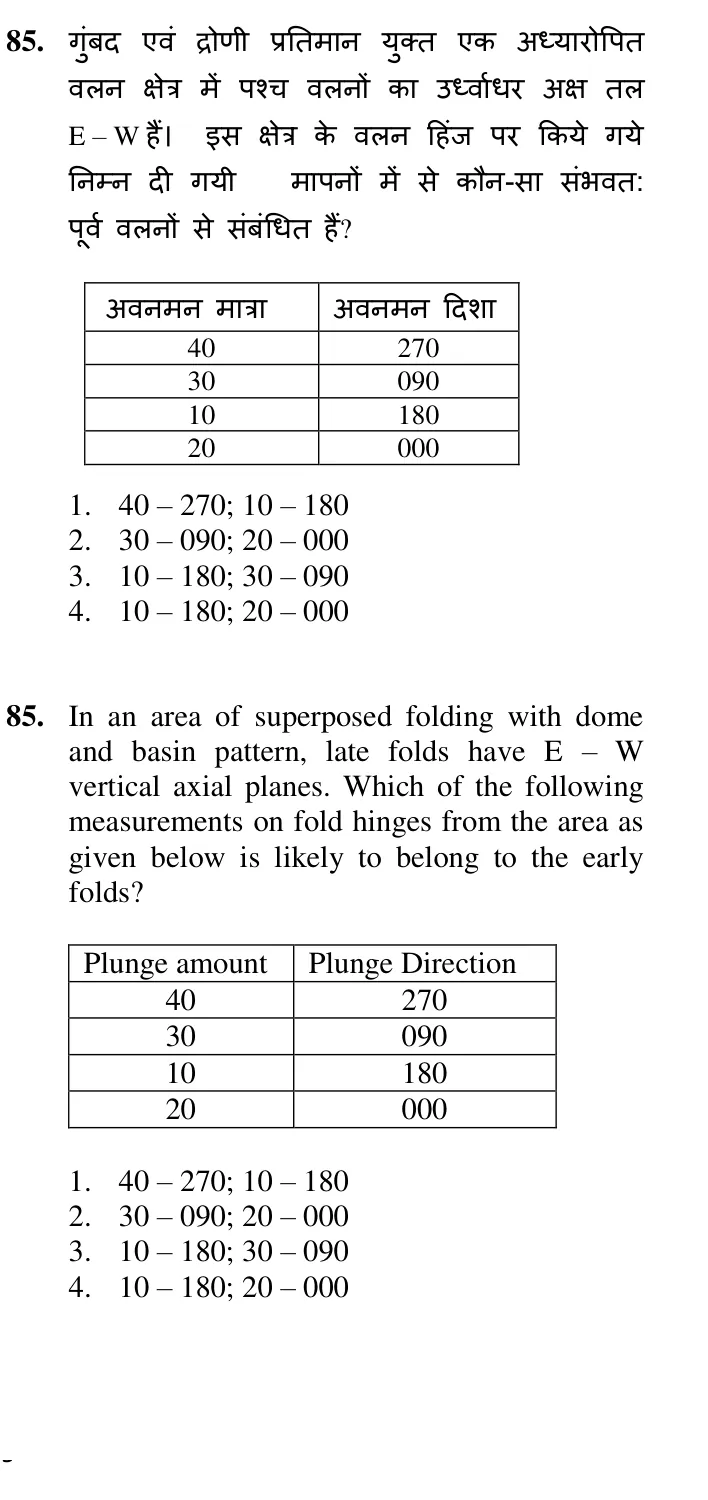
In areas of superposed (interference) folding producing dome-and-basin patterns, two fold generations with differently oriented axial planes/hinges are present; hinge-line orientations help distinguish early (refolded, more variably oriented) from late (consistently oriented) folds.
The late folds are specified to have vertical E-W trending axial planes, so late-fold hinges should plunge shallowly and trend close to E-W (090/270). A dome-and-basin interference pattern arises from two fold sets with axes roughly perpendicular to each other, so the early folds originally trended N-S; their hinges, now modified by the later E-W folding, are recognized by shallow plunges trending N-S (000/180), i.e., 10-180 and 20-000. Option 4 is correct.
1) 40-270 and 10-180 mix an E-W-trending steep hinge (likely a late fold hinge) with only one N-S shallow value — inconsistent pairing. 2) 30-090 and 20-000 mixes an E-W (late-fold-like) measurement with an N-S one. 3) 10-180 and 30-090 again mixes an N-S with an E-W-trending value. 4) Correct — both 10-180 and 20-000 are shallow-plunging, N-S trending, consistent with early folds now overprinted by the E-W late folding.