
CSIR NET June 2016 Q33: Structural Geology
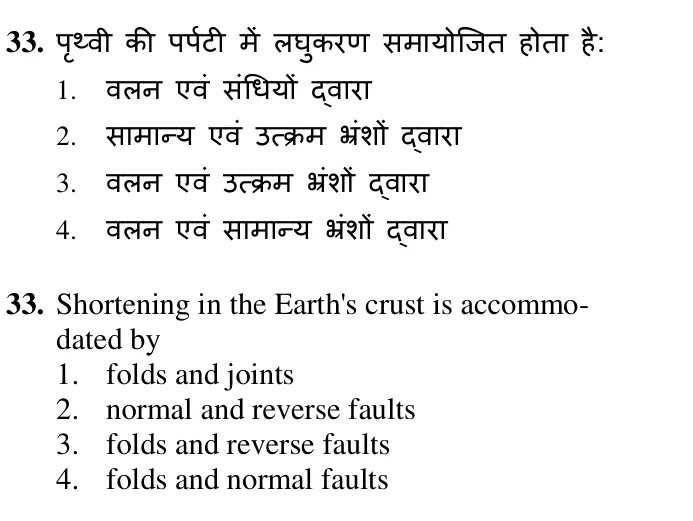
Tectonic shortening (compressional strain) in the crust is accommodated by structures that shorten and thicken rock volumes — primarily folds (ductile bending of layers) and reverse/thrust faults (brittle failure where one block is pushed up and over another, shortening the horizontal extent). Normal faults and simple joints are associated with extension or fracturing, not shortening.
In a compressional tectonic regime, rock layers respond to shortening in two principal ways depending on depth, rock strength, and strain rate: by folding (ductile behaviour, common at deeper/warmer crustal levels or in weaker rocks) and by reverse (thrust) faulting (brittle behaviour, where the hanging wall is pushed up and over the footwall, shortening the horizontal distance across the fault).
Normal faults, by contrast, accommodate extension (crustal lengthening), not shortening, so they are not the correct mechanism here. Joints are fractures without significant displacement and do not by themselves accommodate large-scale shortening.
Normal faults, by contrast, accommodate extension (crustal lengthening), not shortening, so they are not the correct mechanism here. Joints are fractures without significant displacement and do not by themselves accommodate large-scale shortening.
Option 1 (folds and joints) is incorrect because joints alone do not accommodate significant crustal shortening — they lack the displacement that folding and faulting provide.
Option 2 (normal and reverse faults) is incorrect because normal faults accommodate extension, the opposite of shortening.
Option 3 (folds and reverse faults) is correct — both are classic shortening structures.
Option 4 (folds and normal faults) is incorrect for the same reason as option 2 — normal faults are extensional structures, inconsistent with a shortening regime.