
CSIR NET June 2016 Q34: Structural Geology
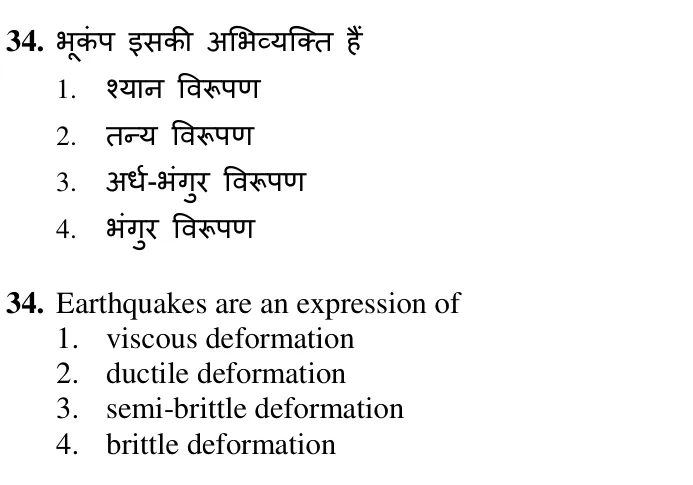
Rocks deform either by permanent, gradual (ductile/plastic) flow or by sudden fracture (brittle failure) once stress exceeds the rock's strength. Earthquakes are the seismic energy release associated with sudden slip on a fault surface — the hallmark of brittle deformation.
An earthquake occurs when accumulated elastic strain energy along a fault is suddenly released as the rock on either side of the fault fractures and slips. This sudden, irreversible rupture and rapid release of stored elastic energy as seismic waves is the defining characteristic of brittle deformation, which typically dominates in the cooler, more rigid upper crust.
Viscous and ductile deformation, in contrast, involve slow, continuous, and generally aseismic flow of rock (common deeper in the crust or mantle where higher temperatures allow rocks to flow rather than fracture), so they do not produce the sudden ruptures that generate earthquakes.
Viscous and ductile deformation, in contrast, involve slow, continuous, and generally aseismic flow of rock (common deeper in the crust or mantle where higher temperatures allow rocks to flow rather than fracture), so they do not produce the sudden ruptures that generate earthquakes.
Option 1 (viscous deformation) is incorrect — viscous flow is a slow, continuous process that does not release energy suddenly as seismic waves.
Option 2 (ductile deformation) is incorrect for a similar reason — ductile flow is gradual and generally aseismic.
Option 3 (semi-brittle deformation) is incorrect; while a transitional regime exists in the crust, earthquakes specifically arise from fully brittle rupture, not this intermediate behaviour.
Option 4 (brittle deformation) is correct — sudden fracture and fault slip are exactly what generates earthquakes.