
CSIR NET June 2016 Q32: Structural Geology
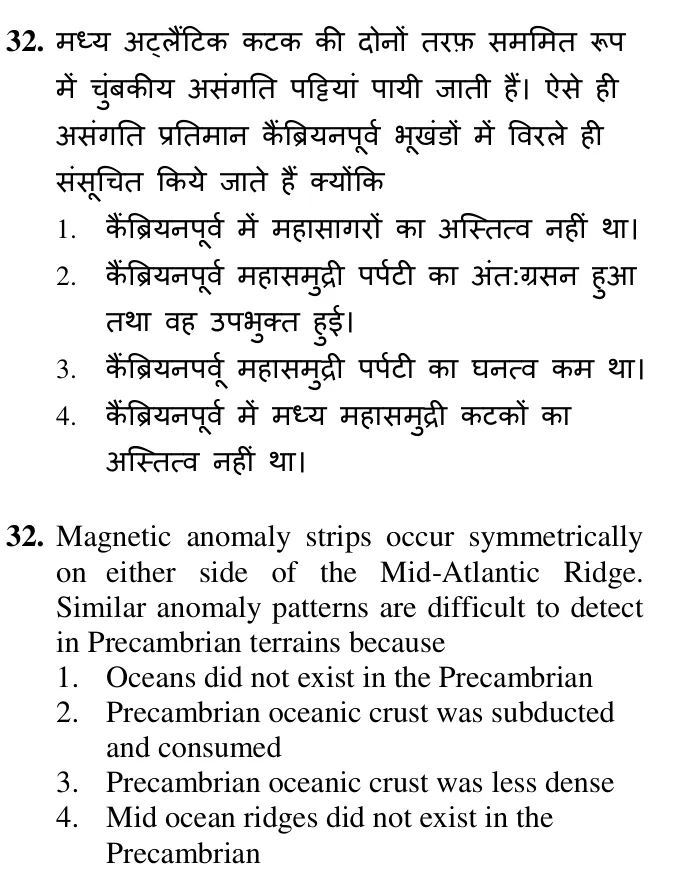
Oceanic crust is continuously created at mid-ocean ridges and destroyed by subduction at convergent margins, giving it a much shorter lifespan than continental crust. As a result, no oceanic crust older than about 200 million years (Jurassic) survives on Earth today.
Symmetric magnetic anomaly stripes on either side of a mid-ocean ridge (like the Mid-Atlantic Ridge) form as newly created oceanic crust records the polarity of Earth's magnetic field at the time of its formation, preserving a time-symmetric record of seafloor spreading.
However, because oceanic crust is constantly being subducted and consumed at convergent plate boundaries, essentially all oceanic crust formed before roughly the Jurassic has already been destroyed. Since Precambrian oceanic crust no longer exists anywhere on Earth's present-day seafloor, there is no ancient oceanic crust left to preserve — and hence no magnetic anomaly stripe pattern from that era can be detected today.
However, because oceanic crust is constantly being subducted and consumed at convergent plate boundaries, essentially all oceanic crust formed before roughly the Jurassic has already been destroyed. Since Precambrian oceanic crust no longer exists anywhere on Earth's present-day seafloor, there is no ancient oceanic crust left to preserve — and hence no magnetic anomaly stripe pattern from that era can be detected today.
Option 1 ('oceans did not exist in the Precambrian') is factually incorrect — oceans have existed on Earth since very early in its history, well into the Precambrian.
Option 2 is correct: Precambrian oceanic crust was subducted and consumed over time, so it simply no longer exists to show anomaly patterns.
Option 3 ('less dense') is not the relevant explanation — density differences do not account for the total absence of preserved Precambrian oceanic crust.
Option 4 ('mid ocean ridges did not exist') is incorrect; plate tectonic processes including seafloor spreading are understood to have operated (in some form) through much of the Precambrian as well, so ridges did exist — the issue is that the crust they produced has since been destroyed.