
CSIR NET June 2016 Q28: Petrology & Mineralogy
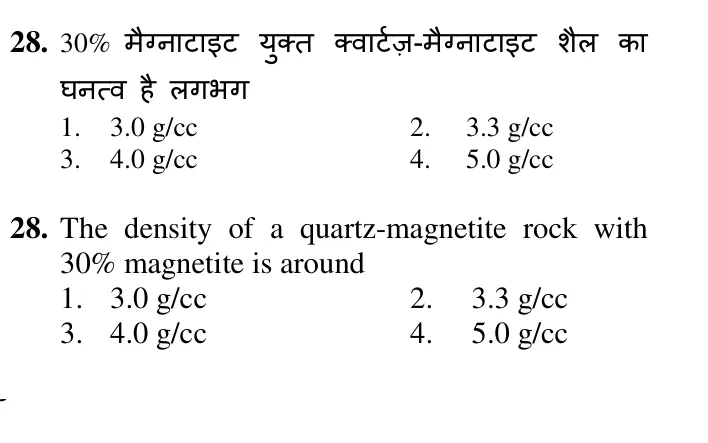
The bulk density of a two-mineral rock can be estimated as a volume-weighted average of the densities of its constituent minerals, given their volume fractions.
Quartz has a density of about 2.65 g/cc, and magnetite has a density of about 5.2 g/cc. For a rock made of 30% magnetite and 70% quartz by volume:
Bulk density ≈ (0.30 × 5.2) + (0.70 × 2.65)
= 1.56 + 1.855
= 3.415 g/cc
This rounds to approximately 3.3–3.4 g/cc, closest to the given option of 3.3 g/cc.
Bulk density ≈ (0.30 × 5.2) + (0.70 × 2.65)
= 1.56 + 1.855
= 3.415 g/cc
This rounds to approximately 3.3–3.4 g/cc, closest to the given option of 3.3 g/cc.
Option 1 (3.0 g/cc) is close to pure quartz's density and does not account for the added magnetite content.
Option 2 (3.3 g/cc) is correct, matching the volume-weighted average of quartz and magnetite densities at a 70:30 ratio.
Option 3 (4.0 g/cc) overestimates the magnetite's contribution, as if the magnetite fraction were considerably higher than 30%.
Option 4 (5.0 g/cc) is close to nearly pure magnetite and greatly overestimates the mixture's density.