
CSIR NET June 2016 Q113: Physical Oceanography
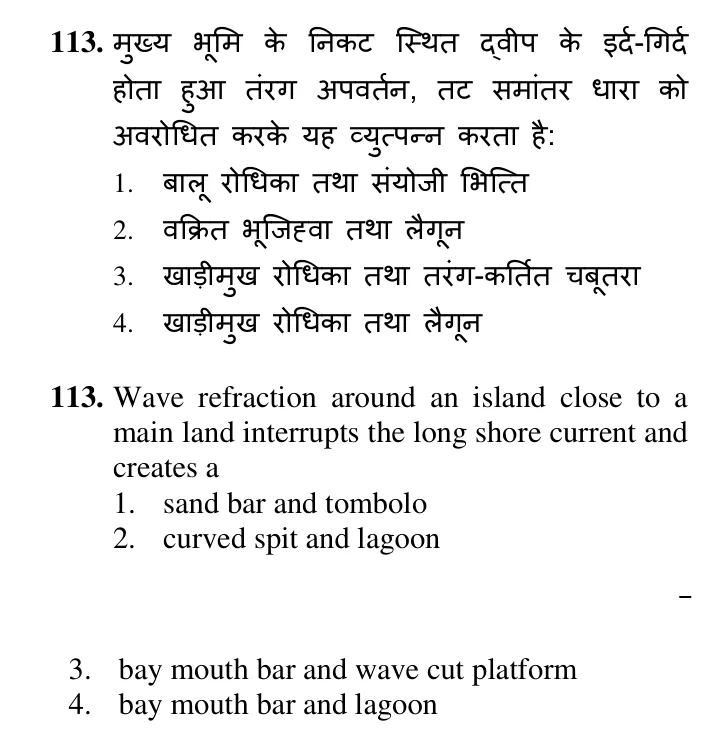
Wave refraction around an island near a mainland reduces wave energy in the island's lee, interrupting longshore drift there and causing sediment to accumulate as a spit that can grow to connect the island to the mainland.
As waves bend (refract) around the island, energy is focused on the island's flanks and reduced directly behind it, creating a low-energy zone where the interrupted longshore current drops its sediment load, forming a sand bar that may extend to link the island with the mainland (a tombolo). Option 1 (sand bar and tombolo) is correct.
1) Correct -- refraction-driven sediment convergence in an island's wave shadow is the classic mechanism for tombolo formation. 2) Curved spits and lagoons typically form along open, uninterrupted coastlines with a change in shoreline orientation, not specifically from island-induced refraction. 3) Bay-mouth bars and wave-cut platforms are associated with embayments and cliff erosion, not island-sheltering effects. 4) Bay-mouth bars with lagoons form by spit growth across an embayment mouth, a different geometry from the island-tombolo case described.