
CSIR NET June 2016 Q72: Geochronology
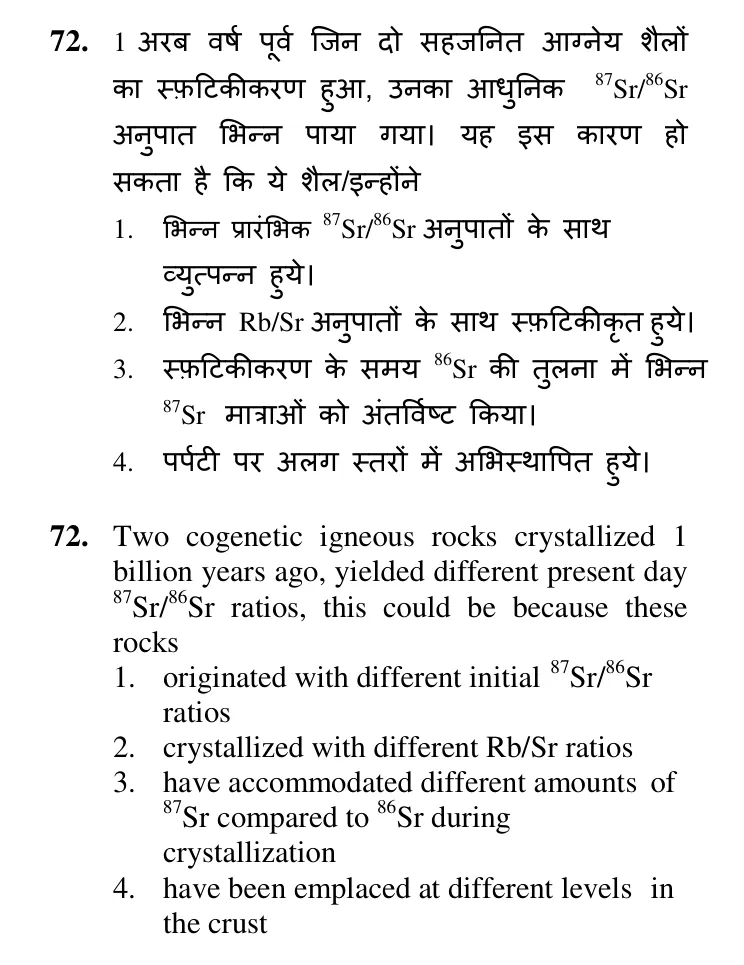
In whole-rock Rb-Sr geochronology, cogenetic rocks with a common initial 87Sr/86Sr ratio evolve to different present-day ratios if they have different Rb/Sr ratios, because 87Sr accumulates from 87Rb decay over time.
87Rb decays to 87Sr with a long half-life (~48.8 billion years), so over 1 billion years, rocks with higher Rb/Sr ratios accumulate proportionally more radiogenic 87Sr, raising their 87Sr/86Sr ratio faster than rocks with lower Rb/Sr, even if all started from an identical initial ratio. This differential radiogenic ingrowth explains divergent present-day ratios in cogenetic rocks. Option 2 is correct.
1) If initial ratios differed, the rocks would not be considered strictly cogenetic with a common source ratio — the question implies a shared origin, so differing Rb/Sr explains the divergence better. 2) Correct — differential radiogenic 87Sr ingrowth from different Rb/Sr ratios is the standard explanation. 3) Sr isotopes are not preferentially incorporated based on isotope mass during crystallization in this manner (no significant fractionation of 87Sr vs 86Sr). 4) Emplacement level (crustal depth) does not by itself change isotope ratios; it's the Rb/Sr ratio and time that control radiogenic ingrowth.