
CSIR NET June 2015 Q129: Geophysical Fluid Dynamics (Rossby Number)
Rossby number as a measure of the relative importance of Earth's rotation (Coriolis effect) for different atmospheric/oceanic flows.
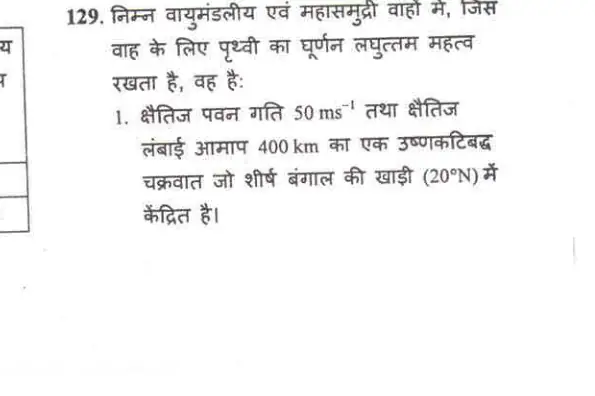
The Rossby number Ro = U/(f*L) quantifies the ratio of inertial to Coriolis forces; a LARGER Rossby number means rotation is LESS important. Using f=2*Omega*sin(latitude) (Omega=7.29e-5 rad/s): For the Bay of Bengal cyclone (20°N, U=50 m/s, L=400 km), Ro~2.5. For the Gulf Stream (30°N, U=0.5 m/s, L=100 km), Ro~0.07. For the Pune sea breeze (19°N, U=5 m/s, L=200 km), Ro~0.53. For the Bangladesh tornado (25°N, U=100 m/s, L=100 m), Ro~16,000 - vastly larger than the others, since the tornado's very small length scale and high wind speed make inertial forces overwhelmingly dominant compared to the Coriolis force.
Option 4 (the tornado) is correct, having by far the largest Rossby number and thus the least rotational influence. The much larger length scales of the cyclone, Gulf Stream, and sea breeze circulations (options 1-3) give them progressively smaller Rossby numbers, meaning rotation plays a more significant role in those flows.