
CSIR NET June 2015 Q128: Planetary Radiative Balance (Albedo Effects)
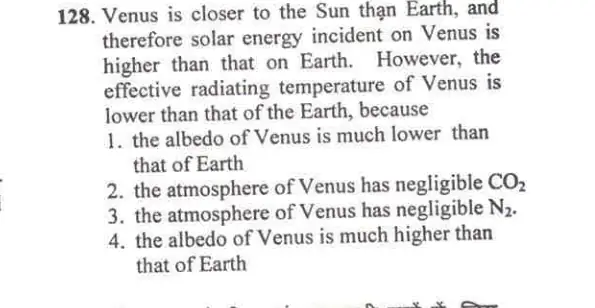
Role of planetary albedo in determining effective radiating temperature, independent of incident solar flux.
Although Venus receives more incident solar energy than Earth (being closer to the Sun), its effective radiating temperature is lower because Venus has a much higher albedo than Earth - its thick, highly reflective sulfuric acid cloud layer reflects the large majority (~70-75%) of incident sunlight back to space, so a much smaller fraction of the incoming solar energy is actually absorbed and available to be re-radiated, resulting in a lower effective (absorbed-flux-based) radiating temperature despite the higher incident flux.
Option 4 (Venus's albedo is much higher than Earth's) is correct, explaining the lower effective radiating temperature via reduced absorbed energy. Option 1 (Venus's distance much smaller) doesn't explain a LOWER radiating temperature (it would suggest higher). Options 2 and 3 (negligible CO2/N2 in Venus's atmosphere) are factually incorrect, since Venus's atmosphere is over 96% CO2.