
CSIR NET June 2015 Q88: Applied Geophysics (Seismic Refraction, Veloci…
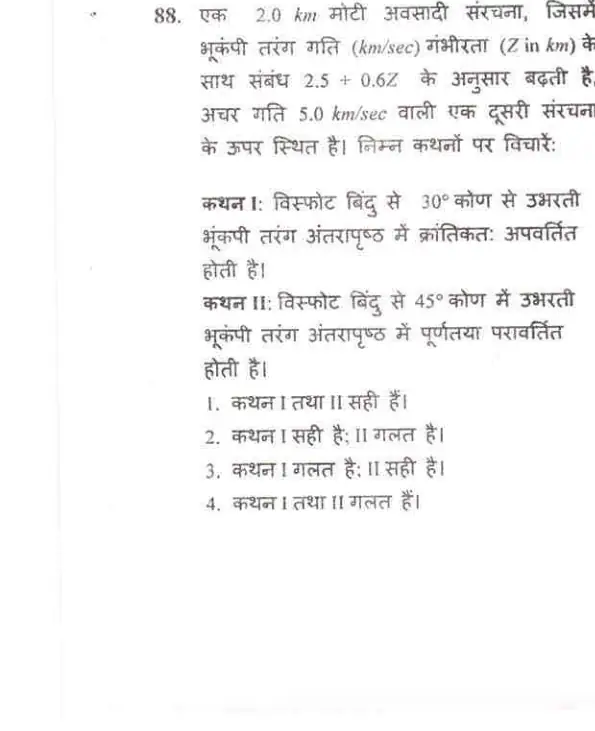
Snell's law / ray parameter analysis for critical refraction and total internal reflection in a linear velocity-gradient layer overlying a higher-velocity half-space.
The ray parameter p = sin(theta)/v is conserved along any ray path. At the shot point (surface), v0 = 2.5 km/s (from v(Z)=2.5+0.6Z at Z=0). Critical refraction at the interface with the underlying v2=5.0 km/s half-space requires p = 1/v2 = 1/5.0 = 0.2. Setting sin(theta0)/v0 = 0.2 gives sin(theta0) = 0.2x2.5 = 0.5, so theta0 = 30°. This confirms Statement I: a wave emerging at 30° indeed has the ray parameter required for critical refraction at the interface, so Statement I is TRUE. For a wave emerging at 45°, p = sin(45°)/2.5 = 0.7071/2.5 ≈ 0.283, which is greater than 1/v2=0.2. Because velocity increases continuously with depth in the gradient layer, this larger ray parameter causes the ray to turn back upward at the depth where v(z)=1/p ≈3.54 km/s, i.e., at Z=(3.54-2.5)/0.6≈1.73 km - which is above the 2 km interface. So this ray never actually reaches the layer boundary; it turns around within the gradient layer itself, not by total reflection precisely 'at the interface' as Statement II claims. Hence Statement II is FALSE.
Option 2 (Statement I true; II false) is correct: the 30° emergence angle exactly satisfies the critical-refraction ray-parameter condition, while the 45° ray turns around within the gradient layer above the interface rather than being reflected at the interface itself.