
CSIR NET June 2016 Q125: Meteorology
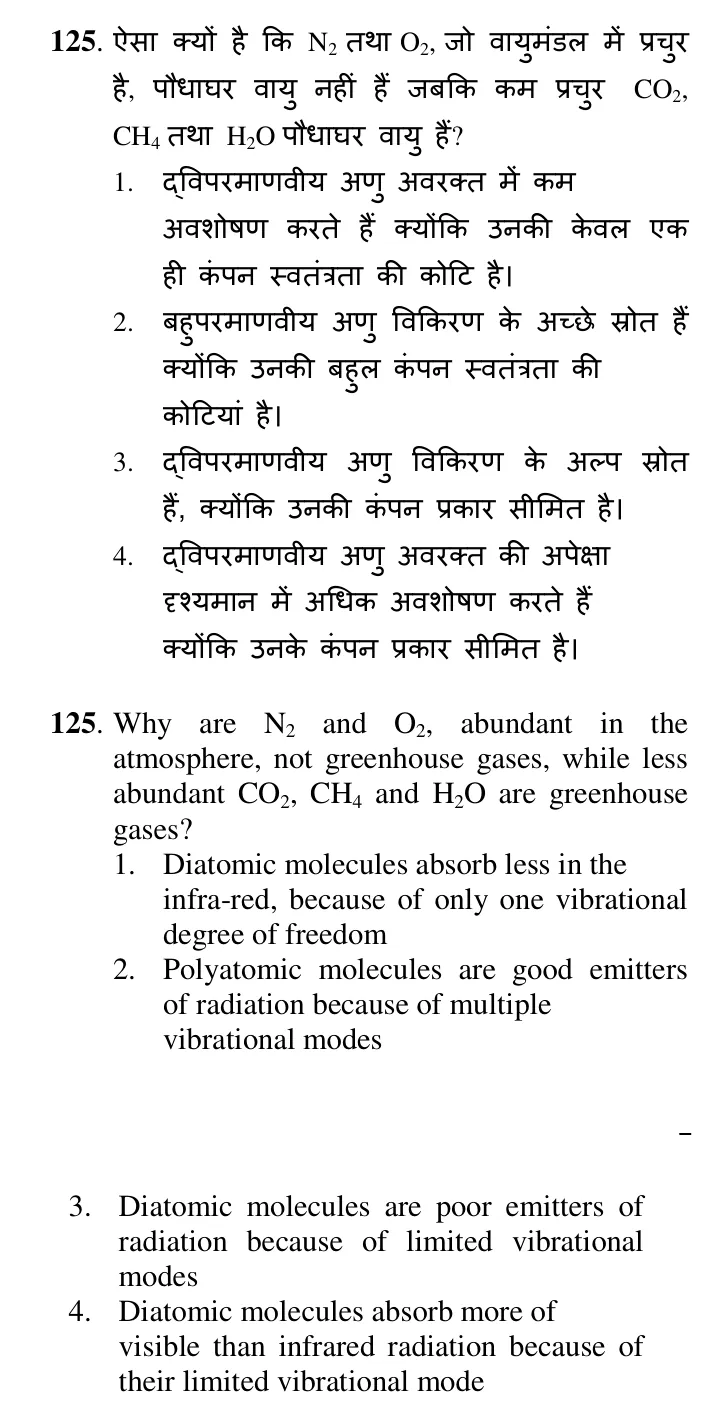
Whether a gas is a greenhouse gas depends on whether its vibrational modes can absorb/emit infrared radiation, which in turn depends on whether those vibrations change the molecule's dipole moment; homonuclear diatomic molecules like N2 and O2 have only one vibrational mode that is IR-inactive by symmetry.
N2 and O2 are homonuclear diatomic molecules with only a single vibrational degree of freedom (the bond-stretch mode), and because this vibration does not change the molecule's (zero) dipole moment by symmetry, it cannot absorb or emit infrared radiation -- making these gases IR-inactive and therefore not greenhouse gases. In contrast, polyatomic/heteronuclear molecules like CO2, CH4, and H2O have multiple vibrational modes that do produce a changing dipole moment, allowing strong IR absorption/emission. Option 1 is correct.
1) Correct -- limited (single, symmetric) vibrational freedom in diatomics like N2/O2 makes them essentially IR-inactive. 2) Incorrect framing -- while polyatomic molecules do have multiple vibrational modes, this option is not the reason diatomic gases fail to be greenhouse gases. 3) Incorrect -- 'limited vibrational modes' is true, but diatomic molecules aren't simply poor 'emitters' in a vague sense; the precise reason is their single mode is IR-inactive by symmetry, as captured in option 1. 4) Incorrect -- N2/O2 do not preferentially absorb visible radiation; the key issue is their lack of IR-active vibrational modes altogether.