
CSIR NET June 2016 Q40: Structural Geology
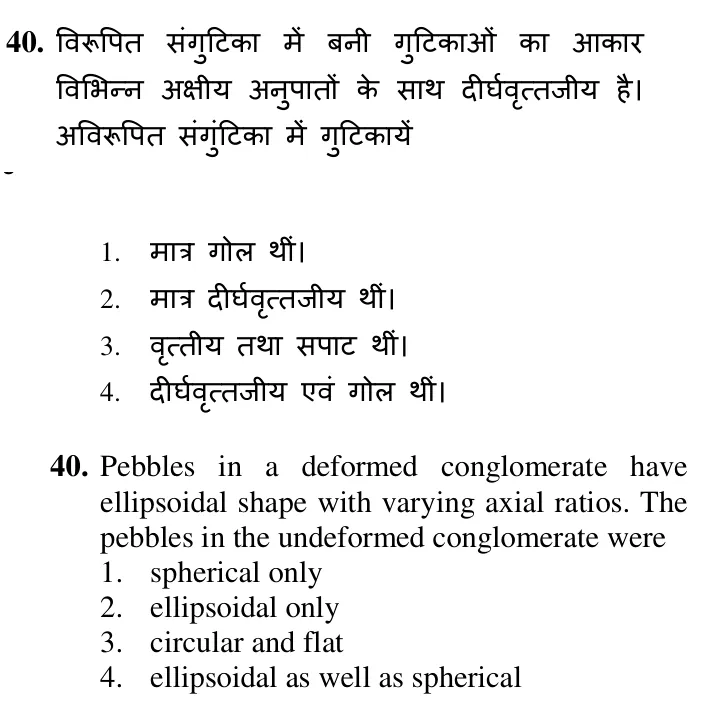
In strain analysis of deformed conglomerates (e.g. the Rf/phi method), the final ellipsoidal shapes and varying axial ratios of pebbles typically reflect a combination of the pebbles' original (pre-deformation) shape variability and the superimposed tectonic strain. If the final population shows a wide range of axial ratios, this is generally attributed to the original sedimentary population itself having contained a range of shapes.
In an undeformed sedimentary conglomerate, pebbles naturally come in a variety of original shapes — some are close to spherical, others are naturally elongated or flattened depending on their source rock and transport history, even before any tectonic deformation occurs. When such a population is later subjected to tectonic strain, the deformation is superimposed on this pre-existing shape variability, producing the observed range of ellipsoidal shapes with varying axial ratios seen in the deformed conglomerate today.
Since the deformed pebbles show a spread of axial ratios rather than a single uniform ellipsoidal shape, this points to the undeformed pebbles having originally been a mix of shapes — both ellipsoidal and spherical — rather than uniformly one shape.
Since the deformed pebbles show a spread of axial ratios rather than a single uniform ellipsoidal shape, this points to the undeformed pebbles having originally been a mix of shapes — both ellipsoidal and spherical — rather than uniformly one shape.
Option 1 (spherical only) would predict a single, uniform final axial ratio after a homogeneous strain, not the observed variation.
Option 2 (ellipsoidal only) would also tend to produce a more uniform (though non-spherical) pattern unless combined with additional shape variability.
Option 3 (circular and flat) describes 2D cross-sectional descriptors that don't correspond to the 3D ellipsoidal shape variation being discussed.
Option 4 is correct: an original population containing both ellipsoidal and spherical pebbles naturally explains the varying axial ratios observed after superimposed tectonic strain.