
CSIR NET June 2016 Q39: Geomorphology
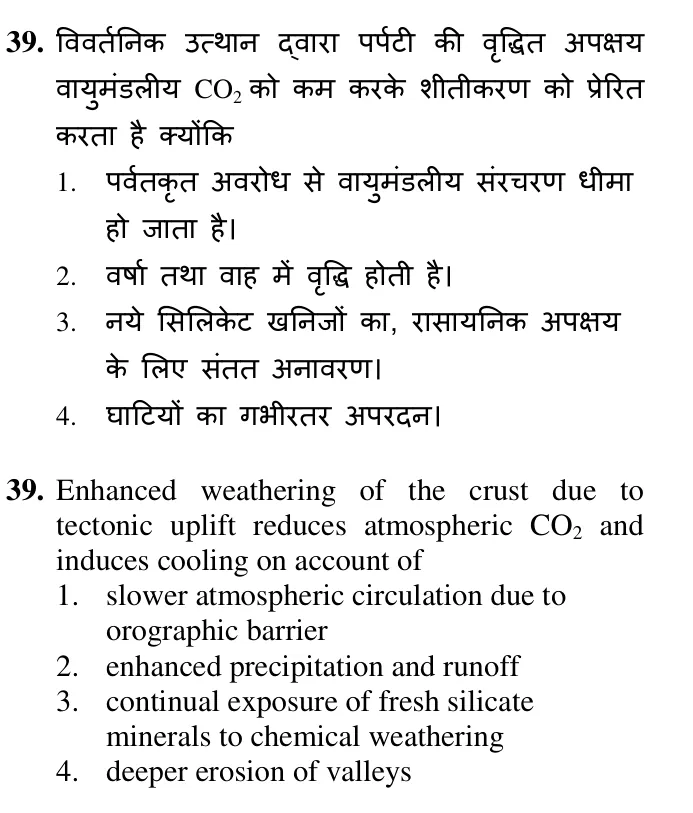
The uplift–weathering hypothesis (Raymo & Ruddiman) proposes that tectonic uplift of mountain ranges accelerates physical erosion, continually exposing fresh, unweathered silicate minerals at the surface. Chemical weathering of these silicate minerals consumes atmospheric CO2, and since CO2 is a greenhouse gas, its removal from the atmosphere over geological timescales drives long-term cooling.
When tectonic uplift raises mountains, rapid erosion strips away weathered material and continually exposes fresh silicate rock to the atmosphere and rainfall. This fresh rock undergoes chemical weathering (e.g. reaction of silicate minerals with carbonic acid derived from atmospheric CO2), which consumes atmospheric CO2 and locks the carbon into weathering products (eventually forming carbonate minerals). Because this process is continually renewed by ongoing erosion exposing new silicate surfaces, the net effect over long timescales is a drawdown of atmospheric CO2, reducing the greenhouse effect and inducing global cooling.
Option 1 (slower atmospheric circulation due to orographic barrier) describes a regional climatic effect of mountains, not the CO2-drawdown mechanism responsible for global cooling.
Option 2 (enhanced precipitation and runoff) is a related hydrological consequence of uplift but is not itself the direct cause of atmospheric CO2 reduction.
Option 3 is correct: it is the continual exposure of fresh silicate minerals to chemical weathering that drives sustained atmospheric CO2 consumption and cooling.
Option 4 (deeper erosion of valleys) describes a geomorphic outcome of uplift but does not by itself explain the CO2/climate linkage.