
CSIR NET June 2016 Q38: Planetary Science
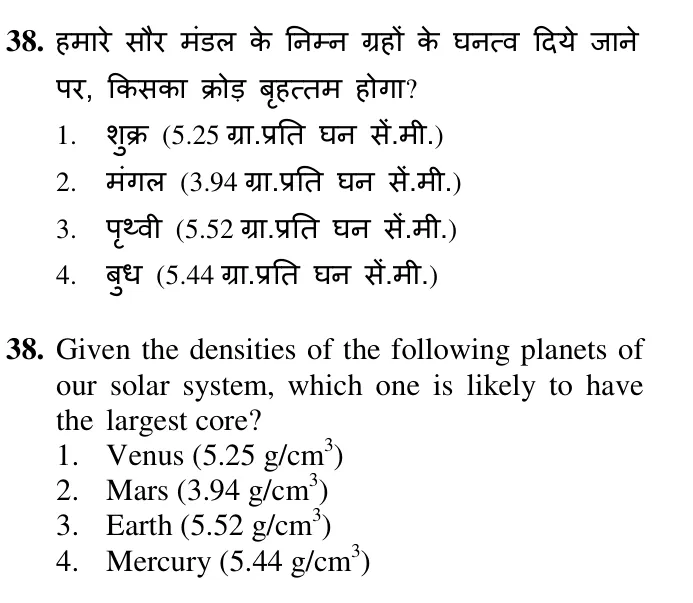
Among rocky (terrestrial) planets with broadly similar silicate mantle compositions, a higher observed bulk density is generally taken as an indicator of a proportionally larger, denser metallic (iron-rich) core relative to the planet's silicate mantle and crust.
Comparing the given bulk densities — Venus (5.25 g/cm³), Mars (3.94 g/cm³), Earth (5.52 g/cm³), and Mercury (5.44 g/cm³) — Earth has the highest bulk density among the four. Assuming broadly similar mantle/crust compositions across these terrestrial planets, the higher the overall density, the larger the proportion of dense metallic (iron) core material relative to the lighter silicate material, so Earth is inferred to have the largest core based on this density comparison.
Option 1 (Venus, 5.25 g/cm³) has a lower density than Earth, implying a comparatively smaller core fraction.
Option 2 (Mars, 3.94 g/cm³) has by far the lowest density of the four, consistent with Mars having a small core relative to its size.
Option 3 (Earth, 5.52 g/cm³) is correct — it has the highest listed density, consistent with the largest core (by this density-based comparison).
Option 4 (Mercury, 5.44 g/cm³) has a high density (in fact Mercury is known to have an unusually large core relative to its small size once self-compression is accounted for), but among the raw densities given here, it is still slightly below Earth's value.