
CSIR NET June 2016 Q36: Structural Geology
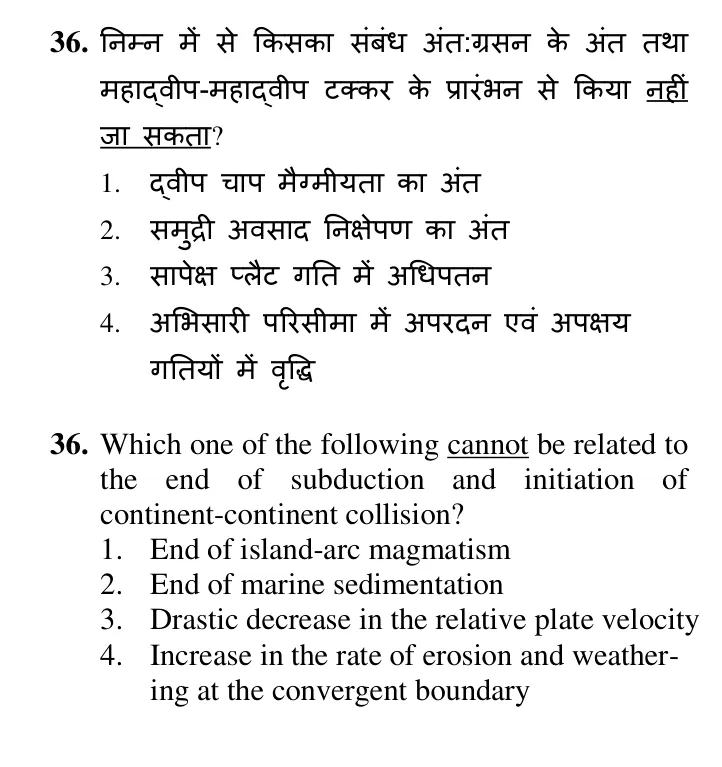
The transition from oceanic subduction to continent-continent collision is marked by several diagnostic geological signatures: cessation of arc volcanism, cessation of marine sedimentation as the intervening ocean closes, and a sharp drop in relative plate convergence rate due to the buoyant resistance of two colliding continental plates. Post-collisional uplift and associated erosion/weathering, by contrast, are longer-term consequences that develop progressively after collision is underway, rather than being direct markers of the initial transition.
As an ocean basin closes and subduction gives way to continent-continent collision: (1) island-arc magmatism ends because there is no more oceanic slab being subducted to generate arc volcanism; (2) marine sedimentation ends in the collision zone because the ocean has closed and no marine basin remains to receive sediment; and (3) relative plate velocity drops sharply because continental crust, being buoyant, resists further subduction, dramatically slowing convergence.
An increase in the rate of erosion and weathering at the convergent boundary, however, is primarily a response to the mountain building (orogenic uplift) that develops as collision proceeds — it is a longer-term geomorphic consequence of ongoing collision and uplift, not a direct, immediate marker of the transition from subduction to collision itself.
An increase in the rate of erosion and weathering at the convergent boundary, however, is primarily a response to the mountain building (orogenic uplift) that develops as collision proceeds — it is a longer-term geomorphic consequence of ongoing collision and uplift, not a direct, immediate marker of the transition from subduction to collision itself.
Option 1 (end of island-arc magmatism) is a genuine and expected consequence of subduction ending — so it can be related to this transition.
Option 2 (end of marine sedimentation) is also a direct, expected consequence, as the intervening ocean basin disappears.
Option 3 (drastic decrease in relative plate velocity) is a well-established consequence of two buoyant continental plates colliding.
Option 4 is correct as the one that cannot be directly related — increased erosion and weathering reflects longer-term post-collisional mountain building rather than being an immediate signature of the subduction-to-collision transition itself.