
CSIR NET June 2016 Q27: Geophysics
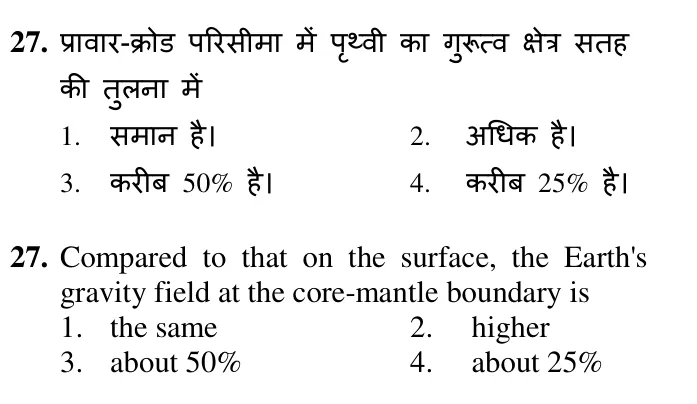
Earth's gravitational acceleration does not simply decrease with depth as it does above the surface; inside the Earth, gravity depends on the mass enclosed within a given radius, and because density increases substantially in the lower mantle and especially across the core-mantle boundary, gravity actually rises with depth through most of the mantle.
Using standard Earth models (e.g. PREM), gravitational acceleration increases gradually from about 9.8 m/s² at the surface to a maximum of about 10.6–10.7 m/s² at the core-mantle boundary, before decreasing again toward the Earth's center (where it approaches zero). This is because, moving down through the mantle, the enclosed mass increases enough (despite the shrinking radius) to raise the gravitational pull, peaking right at the core-mantle boundary.
So compared to the surface, gravity at the core-mantle boundary is higher — though only modestly so (around 8–9% higher), not dramatically different.
So compared to the surface, gravity at the core-mantle boundary is higher — though only modestly so (around 8–9% higher), not dramatically different.
Option 1 ('the same') is incorrect — gravity is not constant with depth inside the Earth; it changes noticeably.
Option 2 ('higher') is correct, matching the known result that gravity peaks near the core-mantle boundary before it starts to decrease deeper into the core.
Option 3 ('about 50%') substantially overstates the actual increase, which is much smaller (order 10%, not 50%).
Option 4 ('about 25%') also overstates the increase; the true figure from standard Earth models is closer to about 9%.