
CSIR NET June 2025 Q134: Remote Sensing / Satellite Orbits
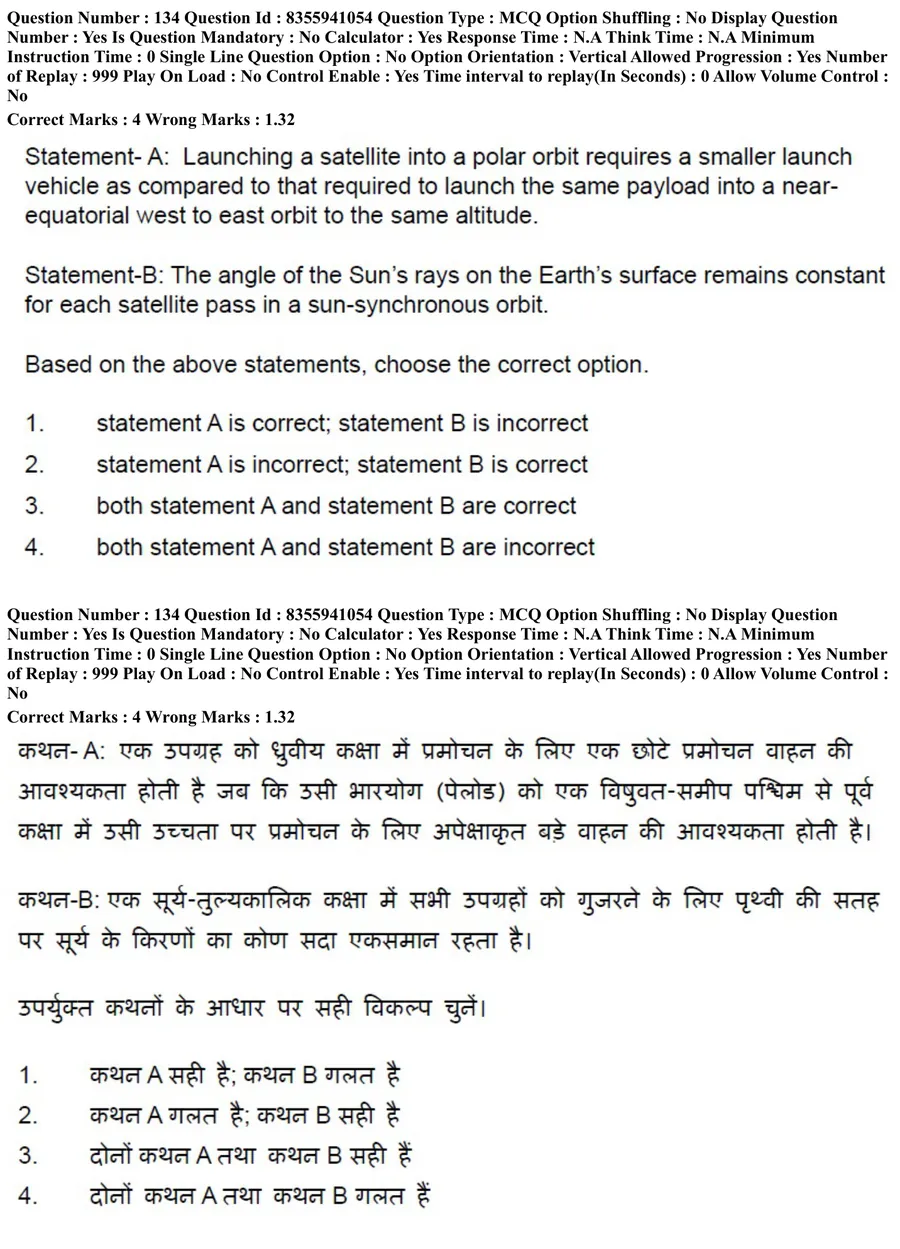
Satellite orbits: launch energy and sun-synchronous orbits
A: an eastward, near-equatorial launch gains about 465 m/s from Earth rotation; a polar launch gets no such boost, so it needs a larger vehicle for the same payload - incorrect. B: a sun-synchronous orbit precesses to keep the same local solar time at every pass, so the solar illumination angle stays nearly the same for each pass - correct.
1. A correct, B incorrect - incorrect. 2. A incorrect, B correct - correct. 3. Both correct - incorrect. 4. Both incorrect - incorrect.