
CSIR NET June 2017 Q150: Marine Carbonate Chemistry
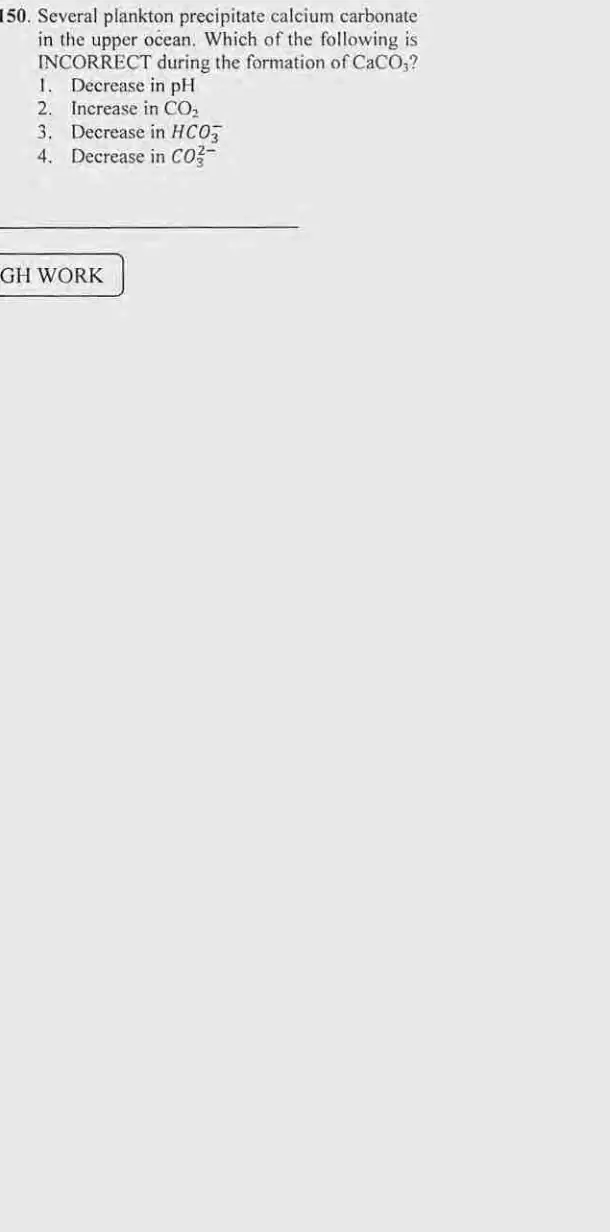
Seawater carbonate chemistry changes during biogenic CaCO3 precipitation
Calcification by marine plankton follows net reactions such as Ca2+ + 2HCO3- -> CaCO3 + CO2 + H2O (equivalently, Ca2+ + CO3^2- -> CaCO3, with the carbonate system re-equilibrating). This process removes carbonate ion (CO3^2- decreases) and, because calcification reduces total alkalinity roughly twice as much as it reduces dissolved inorganic carbon, the carbonate equilibrium shifts to increase aqueous CO2 and decrease pH. However, bicarbonate (HCO3-) does not decrease in this process - as CO3^2- is consumed, the equilibrium reactions (CO2 + H2O <-> H2CO3 <-> H+ + HCO3- <-> 2H+ + CO3^2-) shift to partially replenish carbonate from bicarbonate and CO2, and the net effect on the carbonate system is actually a slight INCREASE in HCO3-, not a decrease. So the claim that HCO3- decreases during CaCO3 formation is incorrect.
1. Decrease in pH - a true consequence of calcification (release of H+ /CO2), not the answer. 2. Increase in CO2 - a true consequence of calcification chemistry, not the answer. 3. Decrease in HCO3- - correct answer (the INCORRECT statement); HCO3- actually increases slightly during CaCO3 precipitation, not decreases. 4. Decrease in CO3^2- - a true consequence, since carbonate ion is directly consumed in forming CaCO3, not the answer.