
CSIR NET June 2017 Q126: Atmospheric Dynamics / Instability Theory
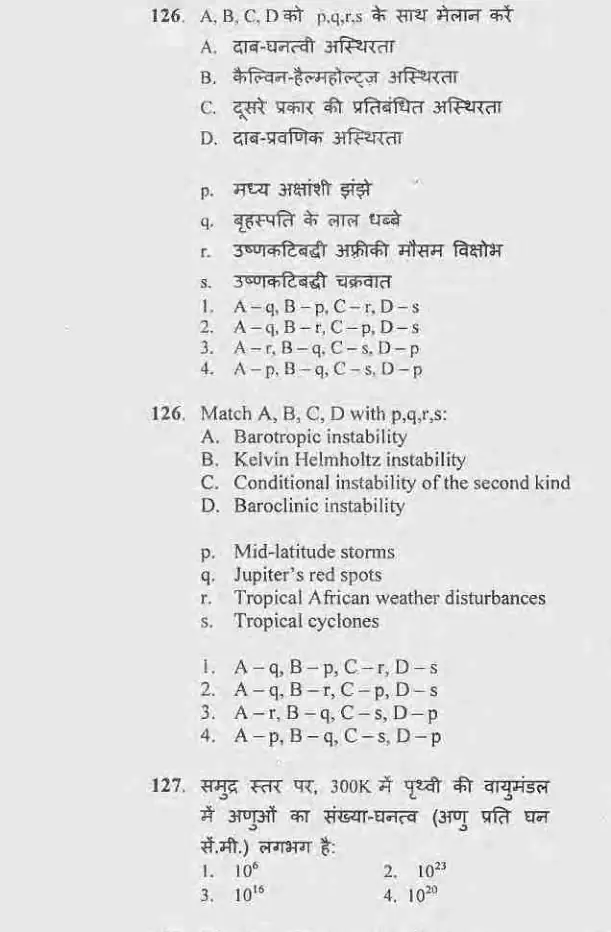
Instability mechanisms and their characteristic atmospheric/planetary phenomena
Barotropic instability, arising from horizontal shear in a jet (e.g., the African Easterly Jet), is a key mechanism generating tropical African easterly wave disturbances (A-r). Kelvin-Helmholtz instability, driven by strong vertical shear at the interface between differently-moving fluid layers, is commonly invoked to explain banded shear-driven features in Jupiter's atmosphere, including dynamics around its Great Red Spot (B-q). Conditional instability of the second kind (CISK) is the classic feedback mechanism (surface-flux/convection coupling) proposed for tropical cyclone genesis and intensification (C-s). Baroclinic instability, arising from horizontal temperature gradients and vertical wind shear in mid-latitudes, is the fundamental mechanism generating mid-latitude storm systems (D-p).
1. A-q,B-p,C-r,D-s - misassigns all four, incorrect. 2. A-q,B-r,C-p,D-s - misassigns A and swaps C/D relationships, incorrect. 3. A-r,B-q,C-s,D-p - correct; matches the well-established instability-phenomenon associations. 4. A-p,B-q,C-s,D-p - contains a duplicate/inconsistent entry and misassigns A, incorrect.