
CSIR NET June 2017 Q116: Soil Mechanics / Sedimentology
Physical and physico-chemical causes of clay cohesion
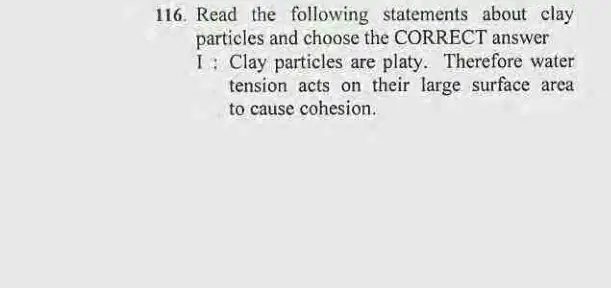
Clay cohesion arises from multiple, simultaneously valid mechanisms. Statement I correctly notes that clay particles have a platy (flat, plate-like) shape, giving them a very large surface area relative to their volume; capillary water tension acting across this large surface area produces cohesive attraction between particles. Statement II correctly notes that clay particles additionally carry electrically charged surfaces (due to isomorphous substitution and broken bonds at particle edges), and electrostatic attraction between these charges and oppositely charged surfaces/ions on neighbouring particles further binds them together. Both mechanisms are genuine, well-established contributors to clay cohesion, so both statements are true.
1. Both are false - incorrect, since both statements describe valid physical mechanisms. 2. I false, II true - Statement I is also correct, incorrect. 3. I true, II false - Statement II is also correct, incorrect. 4. Both are true - correct; both capillary/surface-area and electrostatic mechanisms genuinely contribute to clay cohesion.