
CSIR NET June 2017 Q113: Fluvial Geomorphology
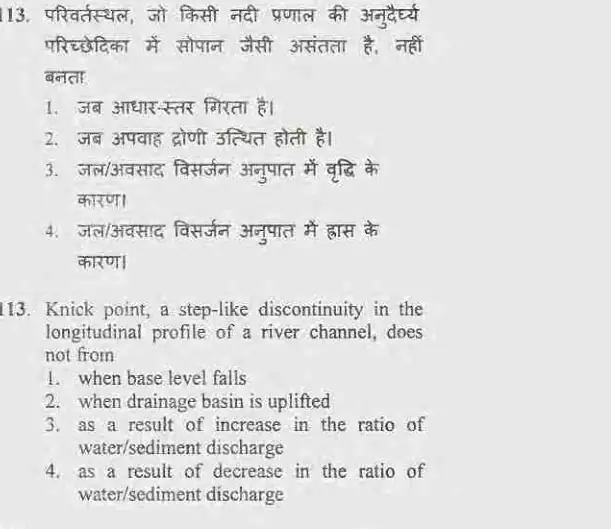
Causes of knickpoint formation in river long profiles
A knickpoint (a step-like break in a river's longitudinal profile) typically forms in response to a relative fall in base level, uplift of the drainage basin (both of which trigger a wave of incision migrating upstream), or an increase in the water/sediment discharge ratio (greater relative erosive power promoting channel incision and profile rejuvenation). Conversely, a decrease in the water/sediment discharge ratio reduces the river's relative transport/erosive capacity, favouring aggradation rather than the formation of an erosional step - so this is the condition that does NOT produce a knickpoint.
1. Base level falls - a well-known knickpoint-forming trigger, so this does form one (not the answer to 'does not form'). 2. Drainage basin uplifted - also a classic knickpoint trigger, not the answer. 3. Increase in water/sediment discharge ratio - increases erosive power, promoting knickpoint formation, not the answer. 4. Decrease in water/sediment discharge ratio - correct; reduced relative erosive capacity favours aggradation, not knickpoint formation.