
CSIR NET June 2017 Q96: Seismology
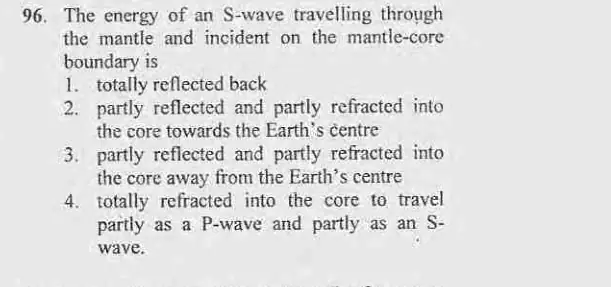
Behaviour of S-waves at the mantle-core boundary
Because the outer core is liquid and cannot sustain shear stress, an S-wave incident on the mantle-core boundary cannot be transmitted into the core as an S-wave. Instead, part of its energy is reflected back into the mantle, while the remainder is refracted (mode-converted) into the core. Because P-wave velocity drops sharply on crossing into the liquid outer core, the refracted ray bends sharply away from the radius (away from the Earth's centre) according to Snell's law - this is the same velocity-drop effect responsible for the well-known P-wave shadow zone between about 103 and 142 degrees epicentral distance.
1. Totally reflected back - ignores that some energy is transmitted (refracted) into the core, incorrect. 2. Partly reflected, partly refracted towards the centre - refraction direction is wrong; the sharp velocity drop bends the ray away from the centre, incorrect. 3. Partly reflected, partly refracted away from the centre - correct; consistent with the velocity-drop-driven bending at the CMB. 4. Totally refracted, partly as P and partly as S in the core - incorrect since the liquid core cannot support any S-wave component.