
CSIR NET June 2017 Q86: Structural Geology / Fold Interference
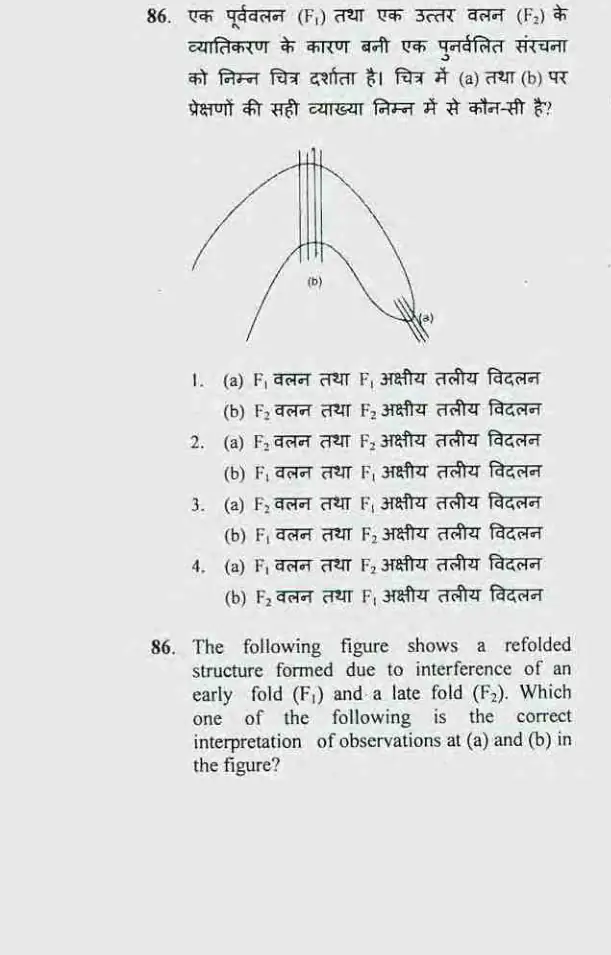
Interpreting refolded (interference) fold structures
In a Type-2/Type-3 fold interference pattern produced by an early fold (F1) refolded by a later fold (F2), the outer, larger-wavelength dome-and-basin outline in the figure represents the later F2 fold, while the tighter, axial-planar fabric cutting steeply through the hinge zone (converging toward point 'a') represents the earlier F1 fold and its associated F1 axial planar cleavage - because that fabric was already present before F2 folding bent it into its present curved trace. At the broader hinge (point 'b'), the observed geometry instead reflects the F2 fold together with F2's own axial planar cleavage developed during the later deformation event.
1. (a) F1 fold and F1 axial planar cleavage; (b) F2 fold and F2 axial planar cleavage - correct; consistent with F1 fabric being refolded and overprinted by the later F2 event. 2, 3, 4. These options mix up which fold generation is associated with which cleavage at points (a) and (b), inconsistent with the refolding sequence shown, incorrect.