
CSIR NET June 2017 Q75: Sedimentology / Sedimentary Structures
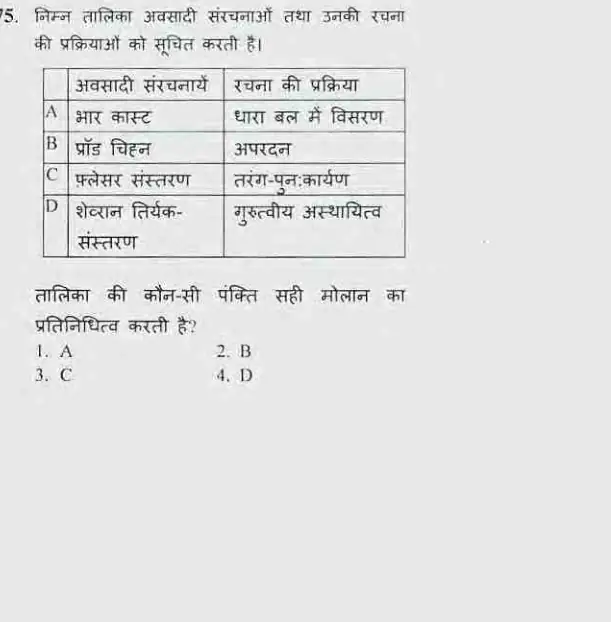
Sedimentary structures and their formative processes
Prod marks are erosional tool marks formed when a rigid object (e.g., a shell, twig, or pebble) carried by a current strikes and digs into a soft, cohesive sediment surface, then is lifted away - classifying them as erosional (scour) structures. This correctly pairs row B (prod marks - erosion). Load casts actually form by soft-sediment loading/density-inversion (not current-stress diffusion), flaser bedding forms from alternating current/slack-water (tidal) deposition rather than simple wave reworking, and chevron cross-stratification is a primary depositional structure, not a gravitational-instability feature - so rows A, C and D pair structures with processes incorrectly.
1. Row A (load cast - stress diffusion in current) - load casts form by soft-sediment loading, not current-stress diffusion, incorrect pairing. 2. Row B (prod marks - erosion) - correct; prod marks are classic erosional tool marks. 3. Row C (flaser bedding - wave reworking) - flaser bedding is primarily a tidal current phenomenon, incorrect pairing as stated. 4. Row D (chevron cross-stratification - gravitational instability) - mismatched process, incorrect.