
CSIR NET June 2017 Q13: Numerical Ability - Algebra
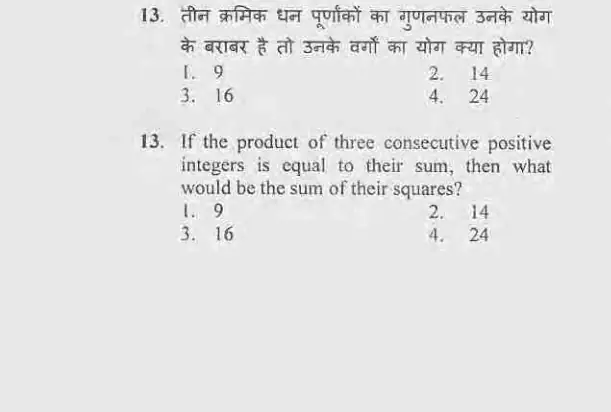
Solving for consecutive integers where the product equals the sum.
Let the three consecutive positive integers be n-1, n, n+1. Their product is n(n-1)(n+1)=n^3-n, and their sum is 3n. Setting these equal: n^3-n=3n, so n^3=4n, and dividing by n (n is nonzero): n^2=4, giving n=2. The three integers are 1, 2, 3, and the sum of their squares is 1+4+9=14.
Option 2 (14) is correct, verified directly: 1x2x3=6=1+2+3, confirming the integers, and 1^2+2^2+3^2=14. The other options do not match this unique valid solution.