
CSIR NET June 2015 Q136: Ocean-Atmosphere Interaction (ENSO)
Characteristic changes in equatorial Pacific ocean conditions (sea level, thermocline, trade winds, Kelvin waves) during an El Nino event.
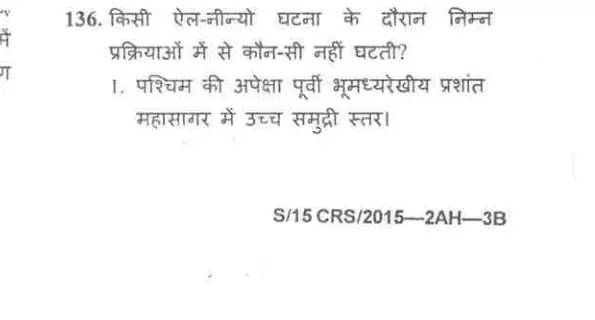
During El Nino, weakening (relaxation) of the equatorial easterly trade winds allows warm water to slosh eastward via an eastward-propagating equatorial Kelvin wave, raising sea level and deepening the thermocline in the eastern equatorial Pacific while lowering sea level in the west - the opposite of normal conditions. Normally (non-El Nino), the thermocline is shallow in the east and deep in the west due to wind-driven upwelling; during El Nino this contrast weakens and the eastern thermocline DEEPENS, so a persistently 'shallow thermocline in the eastern equatorial Pacific compared to west' is a feature of NORMAL (non-El Nino) conditions and does NOT happen during an El Nino event.
Option 2 (shallow thermocline in the east compared to west) is the process that does NOT happen during El Nino, since El Nino instead deepens/flattens the eastern thermocline. Options 1, 3, and 4 (higher eastern sea level, relaxed trade winds, eastward Kelvin wave propagation) are all genuine El Nino characteristics.