
CSIR NET June 2015 Q126: Atmospheric Radiation (Cloud Radiative Effects)
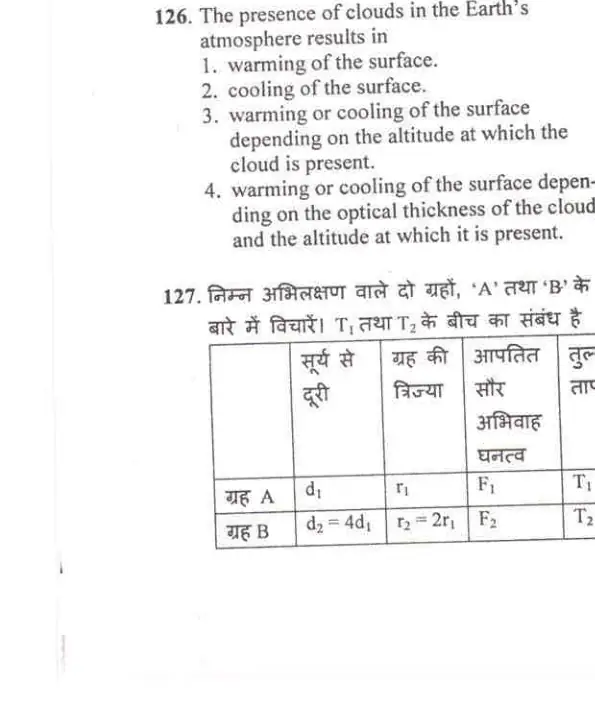
Dual (warming and cooling) radiative effects of clouds on surface temperature, depending on cloud altitude and optical thickness.
Clouds affect surface temperature through two competing radiative effects: a shortwave (albedo) effect, where clouds reflect incoming solar radiation back to space, cooling the surface; and a longwave (greenhouse) effect, where clouds absorb and re-emit outgoing longwave radiation back toward the surface, warming it. The net effect - warming or cooling - depends on both the cloud's altitude (high, cold cirrus clouds tend to have a net warming effect, while low, thick clouds tend to have a net cooling effect) and its optical thickness (thicker clouds reflect more sunlight, enhancing the cooling shortwave effect).
Option 4 (warming or cooling depending on optical thickness and altitude) is correct, capturing the full complexity of cloud radiative effects. Options 1 and 2 oversimplify to a single fixed effect, and option 3 captures only the altitude dependence while omitting the equally important optical thickness dependence.