
CSIR NET June 2015 Q109: Fluvial Geomorphology (Downstream Hydraulic Ge…
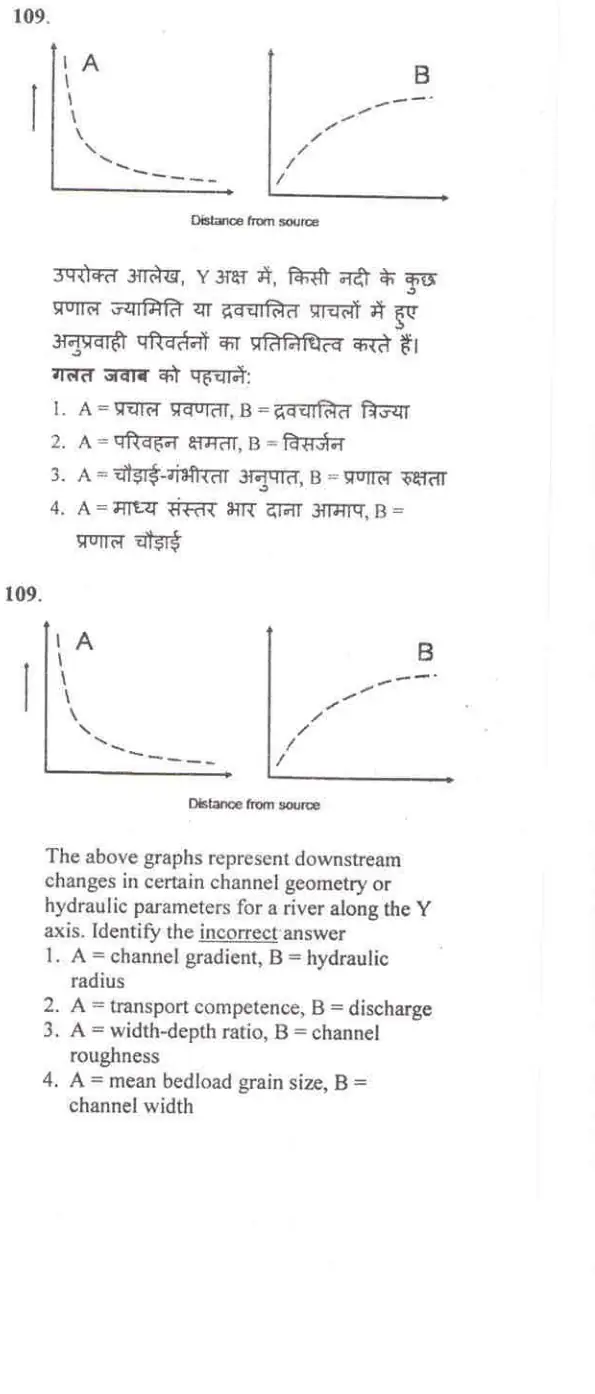
Downstream trends in river channel geometry and hydraulic parameters (gradient, hydraulic radius, competence, discharge, width-depth ratio, roughness, grain size, width).
Along most rivers, channel gradient, mean bedload grain size, transport competence, and channel roughness (Manning's n) all generally DECREASE downstream (matching curve A's decreasing shape), while hydraulic radius, discharge, and channel width generally INCREASE downstream (matching curve B's increasing shape). The width-depth ratio typically INCREASES downstream (channels widen proportionally faster than they deepen), not decreases as curve A would suggest, and channel roughness typically DECREASES (not increases, as curve B would suggest) downstream as grain size fines. Therefore, pairing A=width-depth ratio (decreasing) with B=channel roughness (increasing) is the incorrect assignment.
Option 3 (A=width-depth ratio, B=channel roughness) is the INCORRECT pairing, since both relationships are reversed relative to typical downstream trends. Options 1, 2, and 4 all correctly match decreasing (A) and increasing (B) parameters to their known downstream trends (gradient/hydraulic radius, transport competence/discharge, grain size/width).