
CSIR NET Dec 2015 Q129: Meteorology
Optical formation and color sequence of the primary rainbow
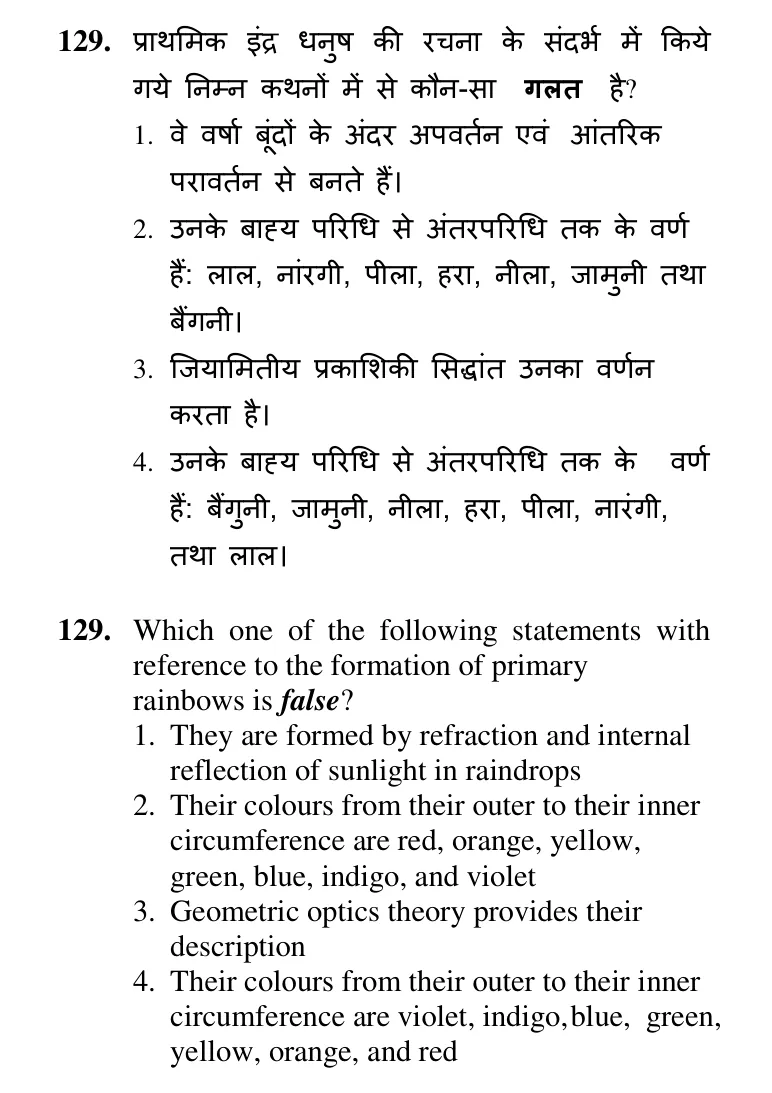
A primary rainbow forms when sunlight enters a spherical raindrop, undergoes refraction upon entry, one internal reflection off the back of the droplet, and then refraction again upon exiting -- described quantitatively by geometric optics theory (Descartes' ray-tracing model). Because different wavelengths of light refract by slightly different amounts (dispersion), the primary rainbow displays a spectrum, with red light (least refracted, exiting at the largest angle, ~42 degrees) appearing on the outer edge of the bow's circumference, progressively transitioning through orange, yellow, green, blue, indigo, and finally violet (most refracted, exiting at the smallest angle) at the inner edge. The statement that colors run in the reverse order, from violet at the outer circumference to red at the inner circumference, is therefore factually false, making option 4 the correct identification of the false statement.
Option 1 (formed by refraction and internal reflection) is a true and standard description of primary rainbow formation, so it is correctly not selected as false. Option 2 (colors from outer to inner circumference: red, orange, yellow, green, blue, indigo, violet) is the correct, true color sequence for the primary rainbow, so it is correctly not selected as false. Option 3 (geometric optics theory describes them) is also true, as Descartes' geometric ray-tracing approach is the classical theoretical description of rainbow formation. Option 4 is correct as the identified FALSE statement: it reverses the true color sequence, incorrectly placing violet at the outer circumference and red at the inner circumference, the opposite of the well-established order for a primary rainbow.