
CSIR NET Dec 2015 Q102: Quantitative Aptitude & Reasoning
Numerical root-finding by the method of false position (regula falsi)
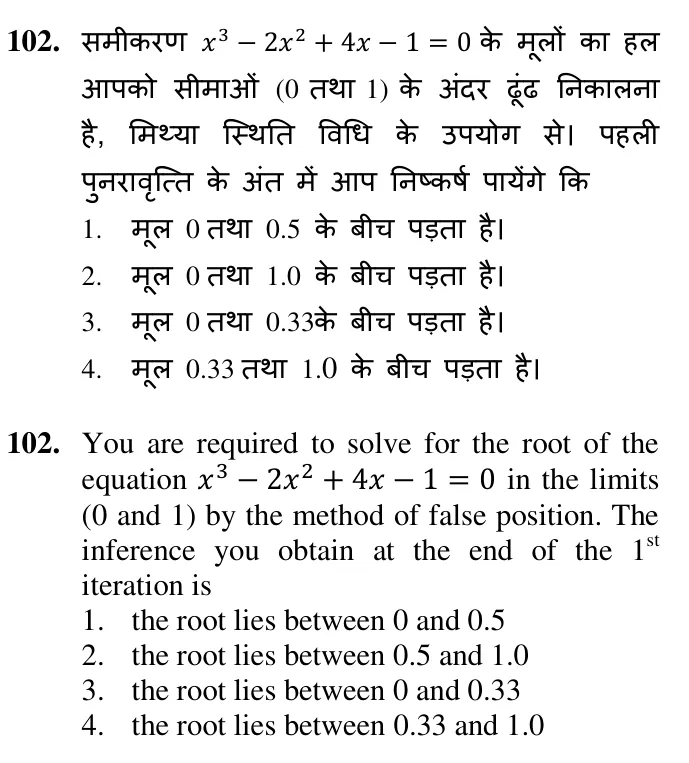
The method of false position finds a root of f(x)=0 within a bracketing interval [a,b] (where f(a) and f(b) have opposite signs) using linear interpolation: x1 = a - f(a)*(b-a)/(f(b)-f(a)). For f(x) = x^3 - 2x^2 + 4x - 1 over [0,1]: f(0) = -1 and f(1) = 1-2+4-1 = 2 (opposite signs, confirming a root lies in [0,1]). Applying the formula: x1 = 0 - (-1)*(1-0)/(2-(-1)) = 1/3 ≈ 0.333. Evaluating f(0.333) = (0.333)^3 - 2(0.333)^2 + 4(0.333) - 1 ≈ 0.037 - 0.222 + 1.333 - 1 ≈ 0.148, which is positive. Since f(0) is negative and f(0.333) is positive, the root must lie between 0 and 0.333, matching option 3.
Option 1 (between 0 and 0.5) is too wide an interval and does not reflect the precise new bound (0.333) generated by the first false-position iteration. Option 2 (between 0.5 and 1.0) is incorrect because the computed interpolation point (0.333) is less than 0.5, and the sign change occurs between 0 and 0.333, not beyond 0.5. Option 3 is correct: after the first iteration, x1=0.333 and since f(0.333)>0 while f(0)<0, the new bracket is [0, 0.333]. Option 4 (between 0.33 and 1.0) reverses the correct bracket; since f(0.333) is positive (same sign as f(1)), the retained bracket must pair 0.333 with the opposite-signed f(0), not with f(1).