
CSIR NET Dec 2015 Q98: Geophysics
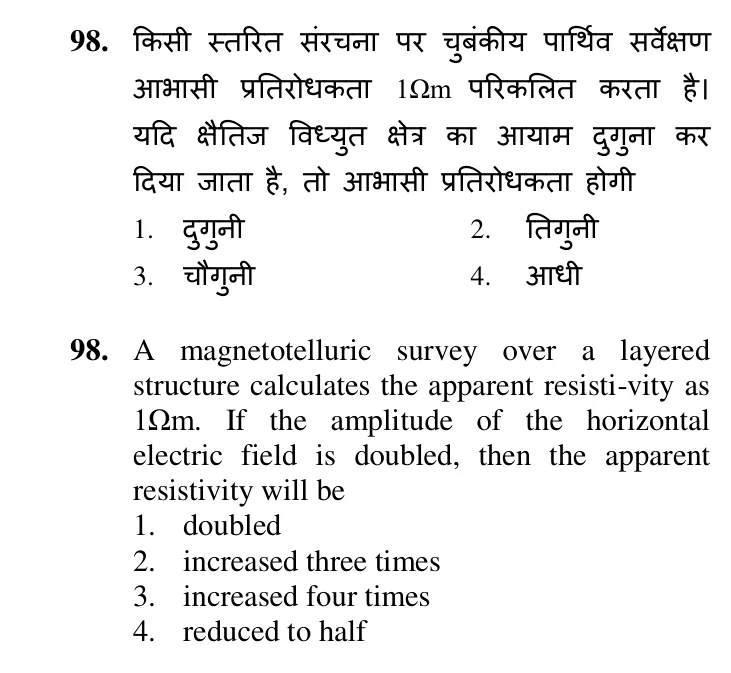
Magnetotelluric apparent resistivity dependence on electric field amplitude
In magnetotelluric (MT) sounding, the apparent resistivity is computed from the ratio of orthogonal horizontal electric (E) and magnetic (H) field components via the Cagniard formula: rho_a = (1/(omega*mu)) * |E/H|^2 = (0.2/f) * |Zxy|^2, where Zxy = Ex/Hy is the surface impedance. Because apparent resistivity depends on the square of the impedance (and hence the square of the electric field amplitude, for a fixed magnetic field), doubling the amplitude of the horizontal electric field quadruples (2^2 = 4 times) the computed apparent resistivity, since rho_a is proportional to |E|^2. Thus the apparent resistivity becomes four times its original value (chaugani / increased four times), matching option 3.
Option 1 (doubled) would apply if apparent resistivity were linearly proportional to E, but the Cagniard formula involves the square of the impedance, not a linear relationship. Option 2 (tripled) does not correspond to any consistent scaling relationship in the MT apparent resistivity formula. Option 3 is correct: since rho_a proportional to |E|^2 (for fixed H and frequency), doubling E quadruples rho_a. Option 4 (halved) would incorrectly imply an inverse relationship between apparent resistivity and electric field amplitude, the opposite of the actual direct-square dependence.