
CSIR NET June 2025 Q67: Marine Ecology / Ocean Acidification
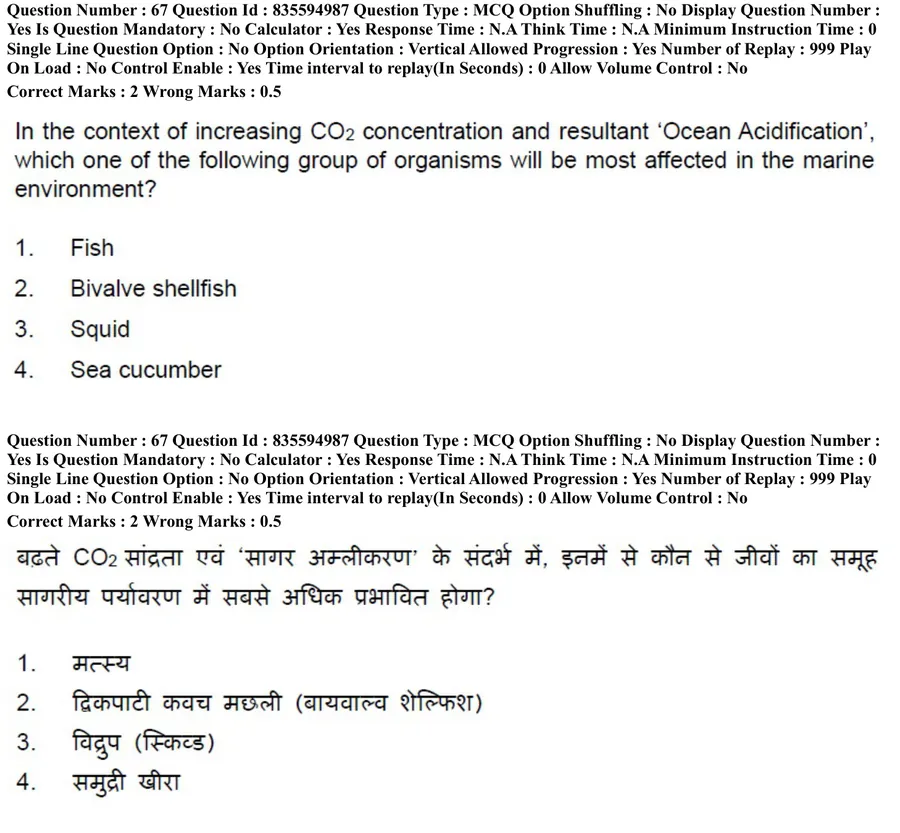
Impact of ocean acidification on calcifying organisms
Rising CO2 lowers ocean pH and carbonate ion concentration, reducing the saturation state of calcium carbonate (aragonite and calcite). Organisms that build CaCO3 shells or skeletons, such as bivalves (oysters, mussels, clams), corals and pteropods, find it harder to calcify, and their shells may dissolve. Bivalve shellfish are therefore the most affected group here.
1. Fish - incorrect; affected physiologically, but they do not depend on CaCO3 shells. 2. Bivalve shellfish - correct; their calcium carbonate shells are directly threatened by lower saturation. 3. Squid - incorrect; they have a reduced internal shell and are less dependent on calcification. 4. Sea cucumber - incorrect; only small calcareous ossicles, so less affected.