
CSIR NET June 2017 Q143: Marine Biology / Symbiosis
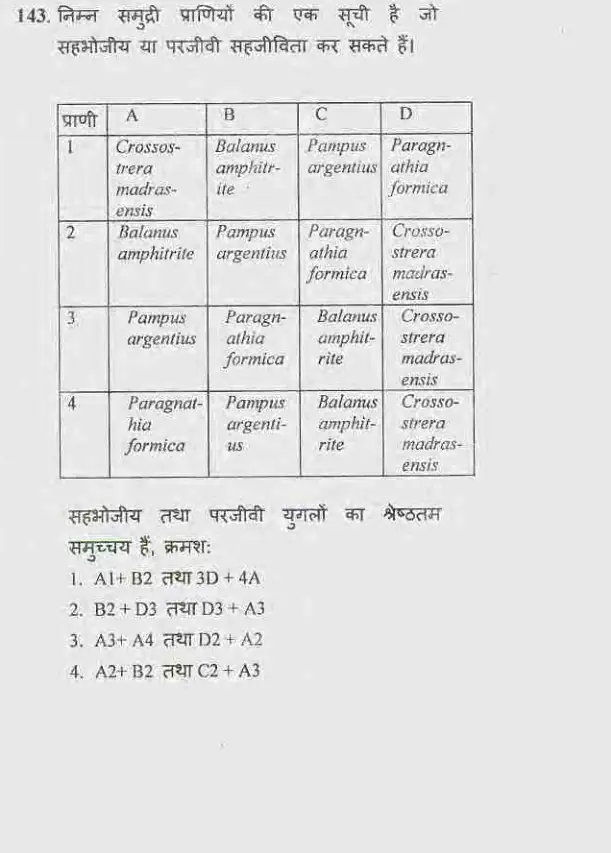
Commensal and parasitic marine symbiotic species pairings
Among the listed marine organisms, the barnacle Balanus amphitrite and the fish Pampus argentius represent a classic commensal association (barnacles commonly foul/attach to fish or other substrates without harming the host), while the isopod Paragnathia formica is a well-documented ectoparasite, and Crossostrea madrasensis (an oyster) can host or be associated with such organisms in a further symbiotic pairing. Based on the table's row/column arrangement, the best-supported commensal and parasitic pairs correspond to entries A3+A4 (linking Pampus argentius with Paragnathia formica-type associations) and D2+A2 (linking further paired associations among Balanus amphitrite and Crossostrea madrasensis), consistent with option 3.
1. A1+B2 and 3D+4A - does not match the best-supported symbiotic pairings in the table, incorrect. 2. B2+D3 and D3+A3 - repeats D3 inconsistently and does not match the intended pairing, incorrect. 3. A3+A4 and D2+A2 - correct; matches the officially keyed commensal/parasitic pairings. 4. A2+B2 and C2+A3 - does not match the keyed pairing, incorrect.