
CSIR NET June 2017 Q142: Marine Geochemistry / Trace Element Residence…
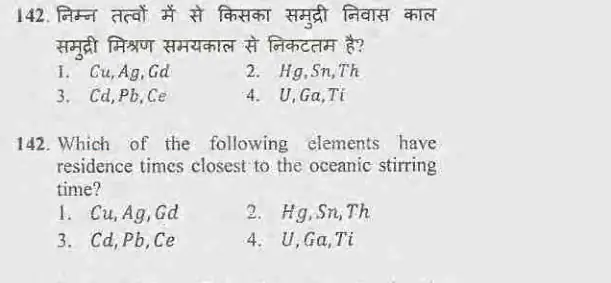
Elemental residence times relative to oceanic mixing (stirring) time
The ocean's internal mixing (stirring) timescale is on the order of a thousand to a few thousand years. Elements whose oceanic residence times fall closest to this timescale are neither extremely particle-reactive (very short residence time, effectively removed before the ocean can mix them, e.g. Al, Mn, Ce under some conditions) nor essentially conservative (very long residence time far exceeding the mixing time, e.g. Na, Cl). Cadmium, lead and cerium have residence times that fall in the range comparable to the ocean's mixing timescale, making them the best match among the given groupings.
1. Cu, Ag, Gd - these generally have residence times not as closely matched to the mixing timescale as the keyed group, incorrect. 2. Hg, Sn, Th - these tend to be highly particle-reactive with much shorter residence times, incorrect. 3. Cd, Pb, Ce - correct; residence times closest to the oceanic stirring/mixing time. 4. U, Ga, Ti - uranium is closer to conservative behavior (long residence time), inconsistent with the group, incorrect.