
CSIR NET June 2017 Q137: Physical Oceanography / Salinity Distribution
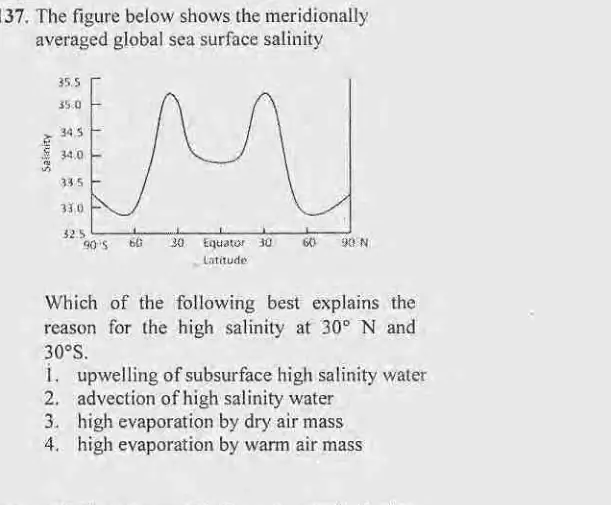
Subtropical sea surface salinity maxima at 30N/30S
The salinity maxima observed near 30 degrees N and S coincide with the subtropical high-pressure belts, where descending, dry air dominates. This dry air has a strong capacity to absorb moisture, driving high rates of evaporation that are not offset by comparable precipitation (these are also regions of minimal rainfall, the subtropical arid belts) - the resulting net moisture loss from the ocean surface concentrates dissolved salts, producing the observed salinity maxima.
1. Upwelling of subsurface high-salinity water - not the primary driver of these open-ocean surface salinity maxima, incorrect. 2. Advection of high-salinity water - a secondary contributor at most, not the best general explanation, incorrect. 3. High evaporation by dry air mass - correct; matches the subtropical high, dry-descending-air-driven evaporation excess. 4. High evaporation due to warm air mass - temperature alone is not the key factor; it is specifically the dryness (low humidity) of the descending air that maximises evaporation, incorrect as the best explanation.