
CSIR NET June 2017 Q120: Atmospheric Dynamics / Monsoon Meteorology
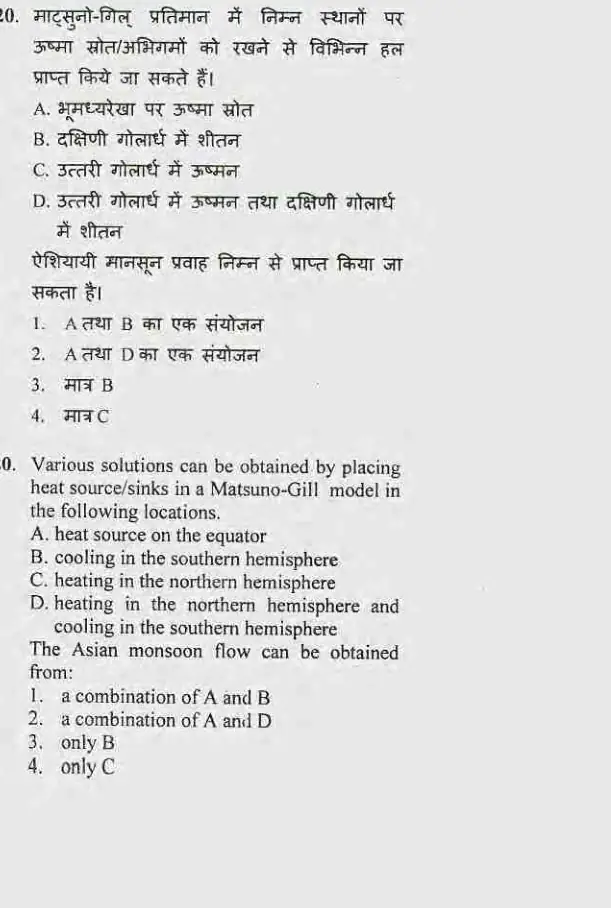
Matsuno-Gill model heat source configurations and the Asian monsoon
In the Matsuno-Gill framework, the atmospheric response to tropical heating depends on both the heating's position relative to the equator and its hemispheric asymmetry. A heat source placed directly on the equator (A) produces the classic symmetric Kelvin-wave (eastward) and Rossby-wave (westward) response pattern. Superimposing an additional asymmetric heating configuration with heating in the Northern Hemisphere and compensating cooling in the Southern Hemisphere (D) introduces the interhemispheric thermal contrast needed to drive strong cross-equatorial low-level flow. The observed Asian summer monsoon circulation, which combines the equatorial heating response with pronounced cross-equatorial flow, is best reproduced by combining these two heating configurations (A and D).
1. Combination of A and B - B alone (cooling confined to the Southern Hemisphere) does not capture the full monsoon heating structure without the Northern Hemisphere heating component, incorrect. 2. Combination of A and D - correct; matches the combined equatorial and asymmetric (N heating/S cooling) forcing needed for realistic monsoon flow. 3. Only B - captures only the southern cooling, insufficient on its own, incorrect. 4. Only C - captures only Northern Hemisphere heating without the equatorial or Southern Hemisphere components, insufficient on its own, incorrect.