
CSIR NET June 2017 Q92: Geodesy / Isostasy
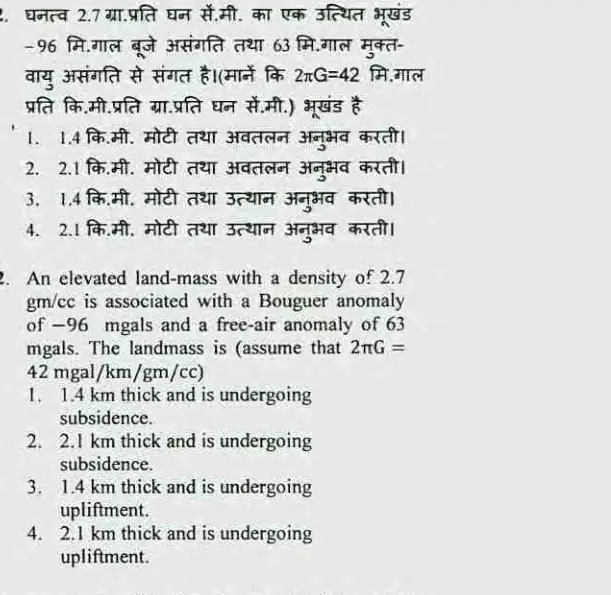
Bouguer and free-air anomalies applied to crustal thickness and isostatic state
The Bouguer anomaly relates to the free-air anomaly via the Bouguer correction: BA = FA - 2*pi*G*rho*h, where h is the thickness of the anomalous mass (root/excess load) and 2*pi*G = 42 mgal/km per g/cc as given. Substituting: -96 = 63 - (42)(2.7)(h) = 63 - 113.4h. Solving: 113.4h = 63 - (-96) = 159, so h = 159/113.4 ~ 1.4 km. Since the observed free-air anomaly remains distinctly positive (63 mgal) rather than near zero, the topographic load is not yet fully isostatically compensated (an excess mass signature persists); such an under-compensated elevated landmass is gravitationally out of equilibrium and tends toward future subsidence as isostatic adjustment proceeds.
1. 1.4 km thick and undergoing subsidence - correct; matches both the computed thickness and the under-compensated (excess mass, positive free-air anomaly) state that drives subsidence. 2. 2.1 km thick and undergoing subsidence - thickness value does not match the calculation, incorrect. 3. 1.4 km thick and undergoing upliftment - thickness matches but the sense of isostatic adjustment is reversed, incorrect. 4. 2.1 km thick and undergoing upliftment - neither the thickness nor the isostatic sense matches, incorrect.