
CSIR NET June 2017 Q80: Petroleum Geology / Source Rocks
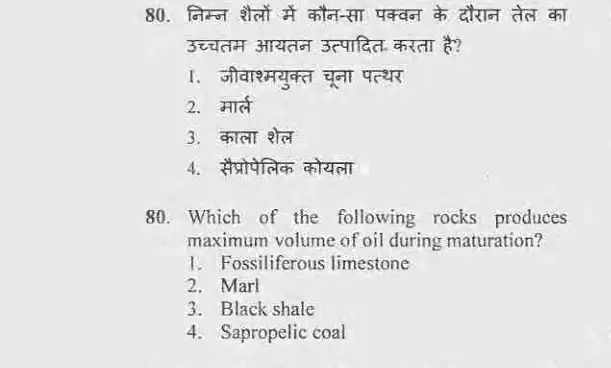
Source rocks with highest oil yield during maturation
The oil-generating potential of a source rock depends on both its total organic carbon content and, critically, the hydrogen richness (kerogen type) of that organic matter. Sapropelic coal is derived from algal/planktonic and finely comminuted organic material deposited in reducing (often lacustrine or restricted marine) settings, giving it a high hydrogen index and Type I/II-like kerogen character - very different from ordinary humic coals. This hydrogen-rich composition allows sapropelic coal to generate and expel the greatest volume of oil per unit rock mass during thermal maturation among the given options.
1. Fossiliferous limestone - typically lower organic richness, modest oil yield, incorrect. 2. Marl - can be a source rock but generally lower oil yield than hydrogen-rich sapropelic material, incorrect. 3. Black shale - a good, common oil source rock, but does not exceed sapropelic coal's oil yield potential, incorrect. 4. Sapropelic coal - correct; hydrogen-rich, oil-prone organic matter gives the highest oil volume on maturation.