
CSIR NET June 2017 Q77: Stratigraphy / Indian Geology
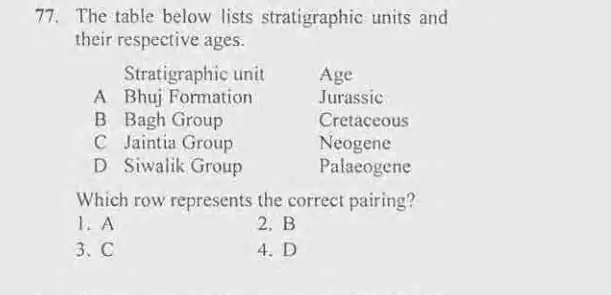
Ages of Indian stratigraphic units
Among the listed units, the Bagh Group of the Narmada valley is a well-established Late Cretaceous (Cenomanian-Turonian) marine sedimentary succession, correctly pairing row B (Bagh Group - Cretaceous). The other pairings are inconsistent with established ages: the Bhuj Formation of Kutch is predominantly Early Cretaceous rather than Jurassic; the Jaintia Group of Meghalaya is Paleogene (Paleocene-Eocene), not Neogene; and the Siwalik Group is a Neogene-Quaternary molasse sequence, not Palaeogene.
1. Row A (Bhuj Formation - Jurassic) - Bhuj Formation is chiefly Early Cretaceous, incorrect pairing. 2. Row B (Bagh Group - Cretaceous) - correct; well-documented Late Cretaceous age. 3. Row C (Jaintia Group - Neogene) - Jaintia Group is actually Paleogene, incorrect. 4. Row D (Siwalik Group - Palaeogene) - Siwalik Group is actually Neogene-Quaternary, incorrect.