
CSIR NET June 2017 Q50: Geodesy / Isostasy
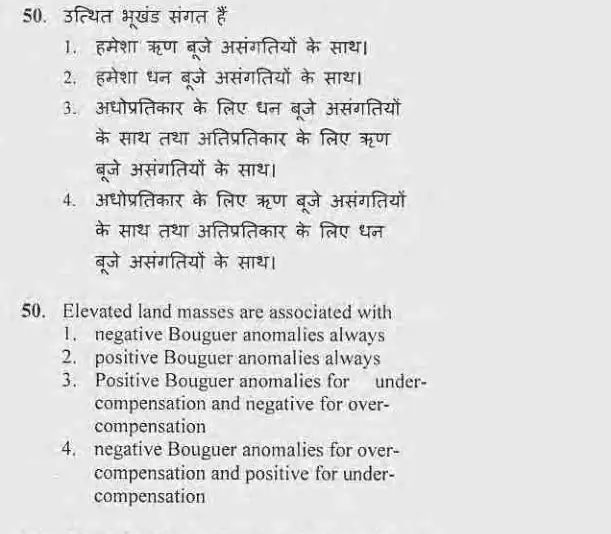
Bouguer anomalies over isostatically compensated elevated terrain
An elevated land mass in perfect isostatic equilibrium produces a negative Bouguer anomaly, because the compensating low-density root below it creates a mass deficiency that outweighs, after the Bouguer correction, the excess topographic mass. If the region is under-compensated (the root/mass deficit is smaller than required for full isostatic balance), the residual excess mass shows up as a positive Bouguer anomaly. Conversely, if the region is over-compensated (root larger than required), the excess mass deficiency produces an even more negative Bouguer anomaly.
1. Always negative - too absolute, ignores under/over-compensation cases, incorrect. 2. Always positive - contradicts the standard isostatic-compensation result, incorrect. 3. Positive for under-compensation, negative for over-compensation - correct. 4. Negative for over-compensation and positive for under-compensation, stated in reverse order - restates the same relationship as option 3 but mislabelled, incorrect as worded.