
CSIR NET June 2017 Q28: Geochronology (Radiocarbon Production)
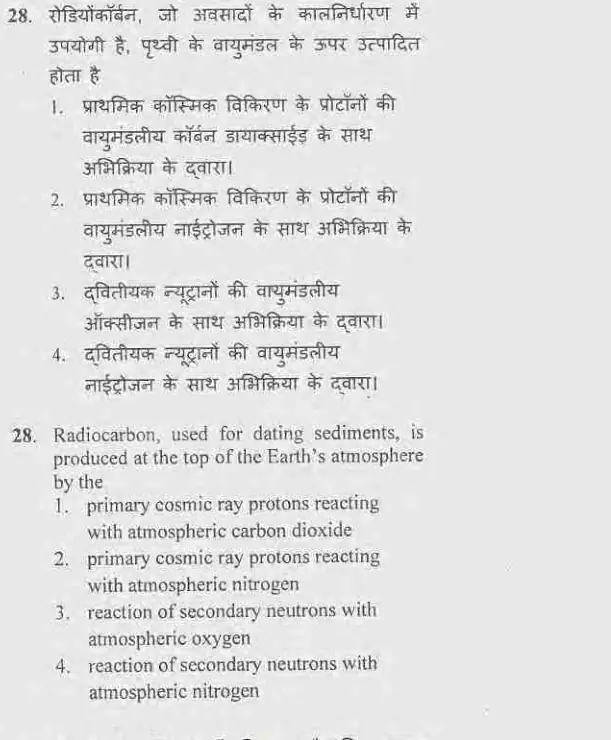
Cosmogenic production mechanism of radiocarbon (14C) in the upper atmosphere.
Radiocarbon (14C) is produced in the upper atmosphere when primary cosmic rays collide with atmospheric molecules, generating secondary neutrons; these secondary neutrons then react with atmospheric nitrogen-14 via the reaction 14N + neutron to yield 14C + a proton. This newly formed 14C then oxidizes to form 14CO2, which enters the global carbon cycle and is eventually incorporated into organisms and sediments, forming the basis of radiocarbon dating.
Option 4 (reaction of secondary neutrons with atmospheric nitrogen) is correct, matching the well-established 14N(n,p)14C production reaction. Options 1 and 2 incorrectly invoke primary cosmic ray protons directly, and option 3 incorrectly invokes oxygen instead of nitrogen.