
CSIR NET June 2017 Q7: Numerical Ability - Logical Reasoning (Roundin…
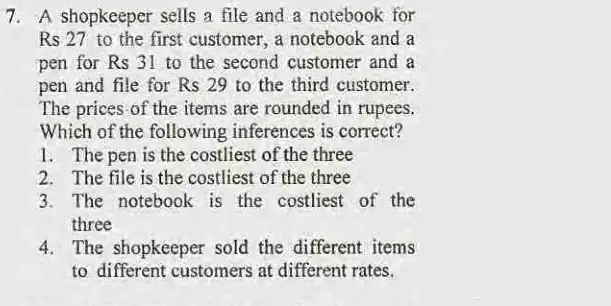
Inferring relative item prices from rounded combined transaction totals (indeterminacy due to rounding).
Adding all three given totals: (file+notebook) + (notebook+pen) + (pen+file) = 27+31+29 = 87, so 2(file+notebook+pen)=87, giving file+notebook+pen=43.5. This implies pen=43.5-27=16.5, file=43.5-31=12.5, notebook=43.5-29=14.5 for the UNROUNDED prices - a fractional (non-integer) result. Since the problem states these totals are prices ROUNDED to the nearest rupee, the true individual item prices cannot be pinned down exactly and are not necessarily self-consistent across the three separate transactions; the only inference that can be drawn with certainty is that rounding means the effective per-item rate implied by each transaction pairing is not guaranteed to be identical across transactions.
Option 4 is correct as the safe, rounding-robust inference. Options 1-3 (claiming a definite costliest item) are not reliably supported once rounding uncertainty is taken into account, since the computed values are non-integer, meaning the true prices are approximations.