
CSIR NET June 2015 Q149: Chemical Oceanography (Trace Element Distribut…
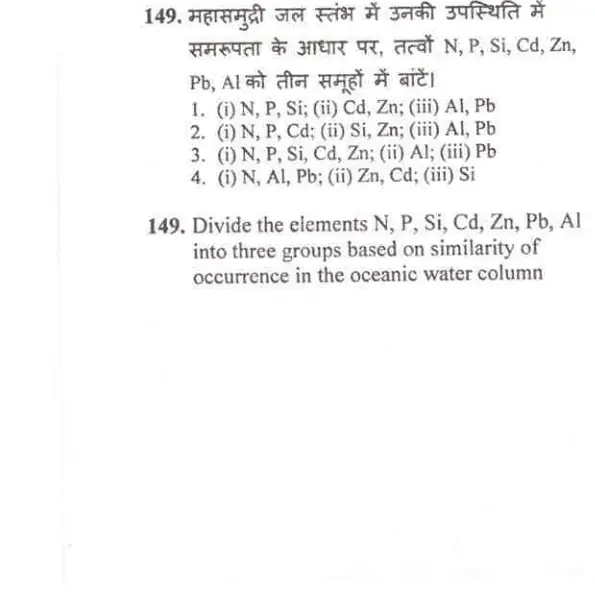
Classification of dissolved elements in the ocean water column by vertical profile type - nutrient-type (phosphate-like), nutrient-type (silicate-like), and scavenged-type.
Dissolved elements in seawater show characteristic vertical profiles based on their biogeochemical cycling. N and P are classical biolimiting nutrients showing strong surface depletion and deep-water regeneration; Cd closely tracks the phosphate profile (a well-documented Cd:PO4 correlation), grouping it with N and P as nutrient-type elements. Zn, in contrast, more closely tracks the silicate profile (regenerated at depth similarly to Si, though from a different biological source, i.e., diatom frustule dissolution/zinc-silica coupling), making Zn better grouped with Si. Al and Pb both show classic scavenged-type profiles, with surface enrichment (from atmospheric dust input) and rapid removal (scavenging) with depth, showing minimal correlation with the nutrient elements.
Option 2 ((i) N,P,Cd; (ii) Si,Zn; (iii) Al,Pb) is correct, reflecting the documented Cd-phosphate and Zn-silicate correlations alongside the Al-Pb scavenged-type grouping. Option 1 groups Si with N and P and separates Cd/Zn together, which does not match the specific documented correlations of Cd with P and Zn with Si.