
CSIR NET June 2015 Q139: Paleoceanography (Stable Isotopes)
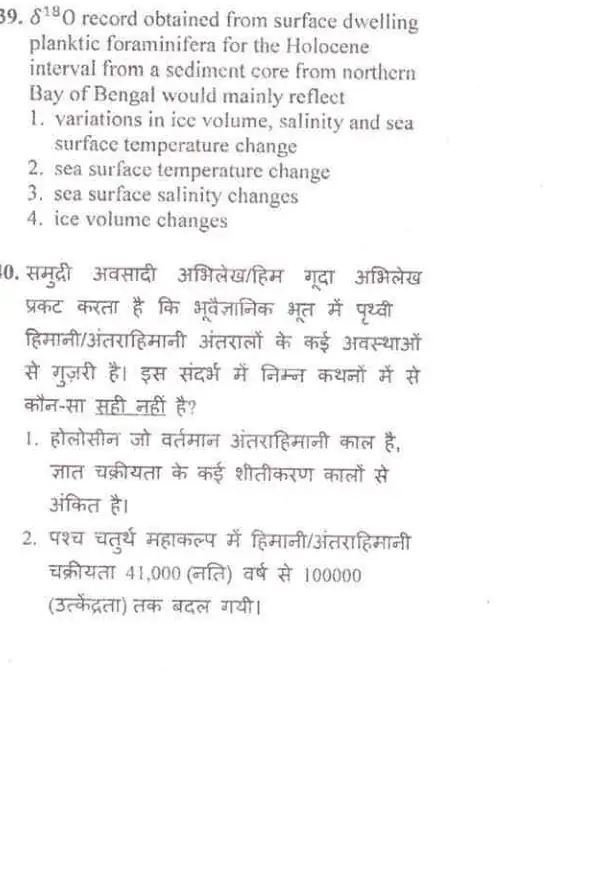
Dominant control on oxygen isotope (delta-18O) variability recorded by surface-dwelling planktic foraminifera in a monsoon-influenced marginal sea (Bay of Bengal).
The Bay of Bengal receives enormous freshwater discharge from major rivers (Ganges-Brahmaputra) and monsoon rainfall, producing strong and highly variable surface salinity gradients that dominate the local oxygen isotope signal in surface waters. During the Holocene, global ice volume has remained essentially constant (no major glaciation), and tropical sea surface temperature variability is comparatively muted, so the delta-18O record from surface-dwelling planktic foraminifera in this setting mainly reflects changes in sea surface salinity (driven by monsoon intensity/river discharge) rather than global ice volume or even temperature.
Option 3 (sea surface salinity changes) is correct, given the dominant monsoon-freshwater control on Bay of Bengal surface water isotopes during the ice-volume-stable Holocene. Option 1 incorrectly includes ice volume, which was essentially stable through the Holocene, and options 2 and 4 (temperature-only, ice-volume-only) ignore the dominant salinity signal characteristic of this region.