
CSIR NET June 2015 Q130: Climate Change (Radiative Forcing)
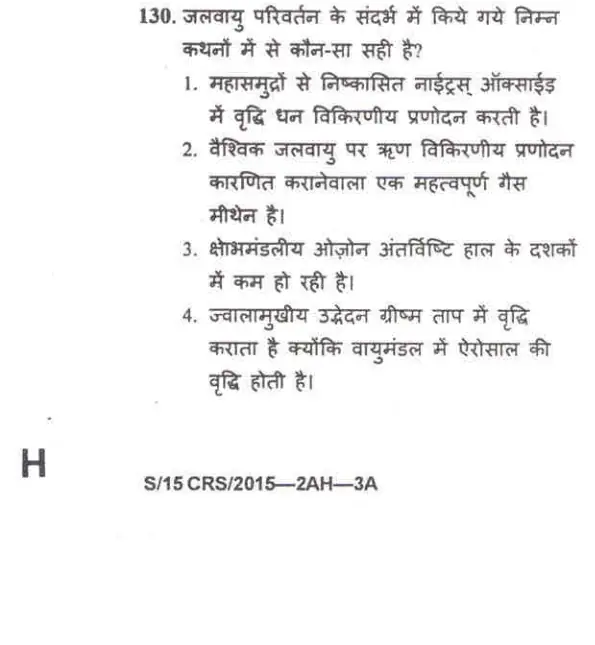
True statements regarding radiative forcing and trace gas trends relevant to climate change (N2O, methane, tropospheric ozone, volcanic aerosols).
Nitrous oxide (N2O), including that released from ocean sources (e.g., via nitrification/denitrification processes enhanced by warming or eutrophication), is a potent greenhouse gas that absorbs outgoing longwave radiation, so an increase in oceanic N2O emissions causes a POSITIVE radiative forcing (warming effect) on the climate system, consistent with N2O being one of the major well-mixed greenhouse gases alongside CO2 and methane.
Option 1 (increase in N2O from oceans causes positive radiative forcing) is correct, consistent with N2O's well-established role as a greenhouse gas. Option 2 is false since methane causes positive (not negative) radiative forcing. Option 3 is false since tropospheric ozone has generally been increasing (not declining) in recent decades due to pollution. Option 4 mischaracterizes volcanic aerosols, which typically cause net cooling (not summer warming) by reflecting sunlight.